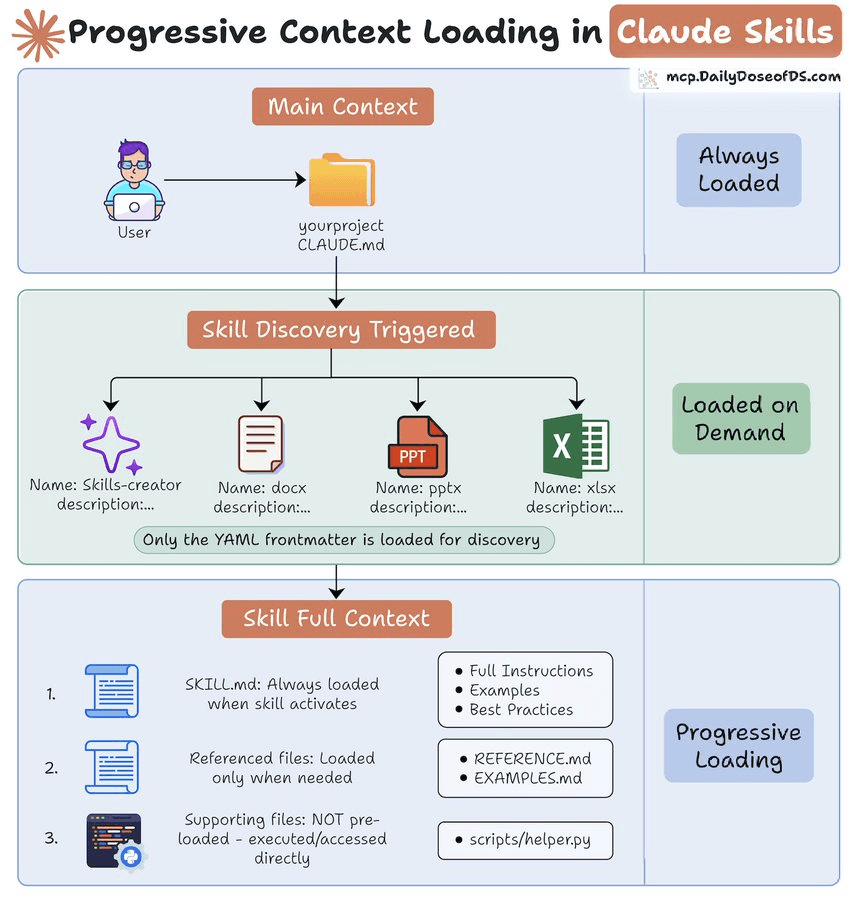
A detailed breakdown of Claude's Skills framework reveals a sophisticated, three-layer context management system designed to overcome one of the most persistent limitations in large language model applications: context window constraints. This architecture enables Claude to support hundreds of specialized skills without breaching token limits, addressing a fundamental scaling challenge in AI agent systems.
What's New: The Three-Layer Context System
The Claude Skills framework organizes context into three distinct layers, each with different loading behaviors and token consumption patterns:
Layer 1: Main Context
- Status: Always loaded
- Content: Project configuration and core system instructions
- Token impact: Constant baseline consumption
Layer 2: Skill Metadata
- Status: Always loaded for all skills
- Content: Only YAML frontmatter (approximately 2-3 lines, < 200 tokens total)
- Token impact: Minimal, scales linearly with number of skills
Layer 3: Active Skill Context
- Status: Loaded on-demand when a skill is invoked
- Content: Full SKILL.md files and associated documentation
- Token impact: Only consumed when skill is actively used
Supporting files like scripts, templates, and external resources follow a zero-token pre-load principle—they're accessed directly when needed rather than being loaded into the context window beforehand.
Technical Implementation: How It Works in Practice
The architecture represents a significant departure from traditional RAG (Retrieval-Augmented Generation) systems that often load entire documents or large chunks of context. Instead, Claude Skills uses a metadata-first approach where:
- Skill discovery happens through the lightweight YAML frontmatter that describes each skill's purpose, inputs, outputs, and triggers
- Skill execution only loads the full implementation details when specifically invoked
- Resource management keeps supporting files outside the LLM context until required
This approach effectively creates a "virtual context window" that appears much larger than the actual token limit, since only relevant portions of hundreds of potential skills occupy context at any given time.
Why This Architecture Matters
For developers building on Claude, this architecture solves several practical problems:
Scalability: Previously, adding more skills meant either hitting context limits or implementing complex external retrieval systems. The three-layer approach allows skill libraries to grow without architectural changes.
Performance: By keeping only metadata in context, Claude maintains faster inference times since it's not processing hundreds of pages of documentation on every query.
Maintainability: Skills can be updated independently without affecting the core system context, and new skills can be added without retraining or reconfiguring the entire system.
Cost efficiency: Reduced context usage translates directly to lower API costs, especially for applications with large skill libraries.
Comparison to Alternative Approaches
Claude 3-Layer System Metadata-only for idle skills Hundreds Medium (built-in framework) Traditional RAG Full documents/chunks Limited by context window High (external vector DB) Function Calling All function definitions Dozens before context limit Low (but limited) External Skill Registry None until retrieved Unlimited Very High (custom infra)Practical Implications for AI Agent Development
This architecture enables several previously challenging use cases:
- Enterprise skill marketplaces: Companies can deploy Claude with hundreds of department-specific skills without performance degradation
- Specialized professional assistants: Legal, medical, or engineering assistants can access vast libraries of specialized knowledge on-demand
- Multi-tenant AI systems: SaaS platforms can offer customized skill sets to different customers from a shared Claude instance
Limitations and Considerations
While innovative, the approach has tradeoffs:
- Cold start penalty: First-time skill invocation requires loading full context, potentially adding latency
- Skill dependency management: Complex skill chains might require loading multiple full contexts simultaneously
- Metadata design constraints: Skill effectiveness depends heavily on well-designed YAML frontmatter for accurate routing
gentic.news Analysis
This technical revelation about Claude's Skills architecture represents Anthropic's systematic approach to solving the context window problem through software architecture rather than just increasing token limits. While competitors like OpenAI have focused on expanding context windows (GPT-4 Turbo's 128K tokens, with rumors of even larger windows in development), Anthropic is taking a more nuanced approach that optimizes for practical deployment scenarios.
The three-layer system aligns with trends we've observed across the AI agent ecosystem. In November 2025, we covered Cognition Labs' Devin architecture which uses similar on-demand loading for its tool library. What makes Claude's implementation notable is its integration directly into the core framework rather than as an external add-on.
This development also reflects the maturation of Claude's enterprise positioning. While ChatGPT focuses on broad consumer capabilities, Claude has been steadily building out features tailored for complex, multi-skill business applications. The Skills framework, combined with Claude's strong performance on coding and reasoning benchmarks, creates a compelling package for developers building sophisticated AI agents.
Looking forward, we expect to see this architecture influence how other AI companies design their agent frameworks. The metadata-first approach provides a scalable middle ground between simple function calling and complex external retrieval systems. As AI applications move from prototypes to production, these architectural decisions will become increasingly important for cost, performance, and maintainability.
Frequently Asked Questions
How does Claude's Skills context system compare to OpenAI's function calling?
Claude's three-layer system is more sophisticated than OpenAI's basic function calling. While OpenAI's approach loads all function definitions into context (limiting how many functions you can have), Claude only loads metadata for idle skills and full implementations only when invoked. This allows Claude to support hundreds of skills versus dozens with traditional function calling before hitting context limits.
Can I use this Skills framework with Claude's API?
Yes, the Skills framework is available through Anthropic's API, though implementation details may vary between the web interface and API usage. Developers building on Claude can implement similar architecture patterns in their applications by separating skill metadata from full implementations and using conditional loading based on user queries.
Does this architecture work with Claude 3.5 Sonnet and other Claude models?
The Skills framework is model-agnostic within the Claude family and works with Claude 3.5 Sonnet, Claude 3 Opus, and other variants. The context management happens at the framework level rather than the model level, though larger context windows in newer models provide additional headroom for complex skill chains.
How do I create a skill that works well with this three-layer system?
Effective skills require carefully designed YAML frontmatter that accurately describes the skill's purpose, triggers, inputs, and outputs. The metadata should be concise (under 200 tokens) yet descriptive enough for Claude to determine when to invoke the skill. The full skill documentation in the SKILL.md file should be comprehensive but organized for efficient loading when needed.