Listen to today's AI briefing

Daily podcast — 5 min, AI-narrated summary of top stories

Dexter: An Autonomous AI Agent for Deep Financial Research, Open-Sourced on GitHub

Dexter: An Autonomous AI Agent for Deep Financial Research, Open-Sourced on GitHub

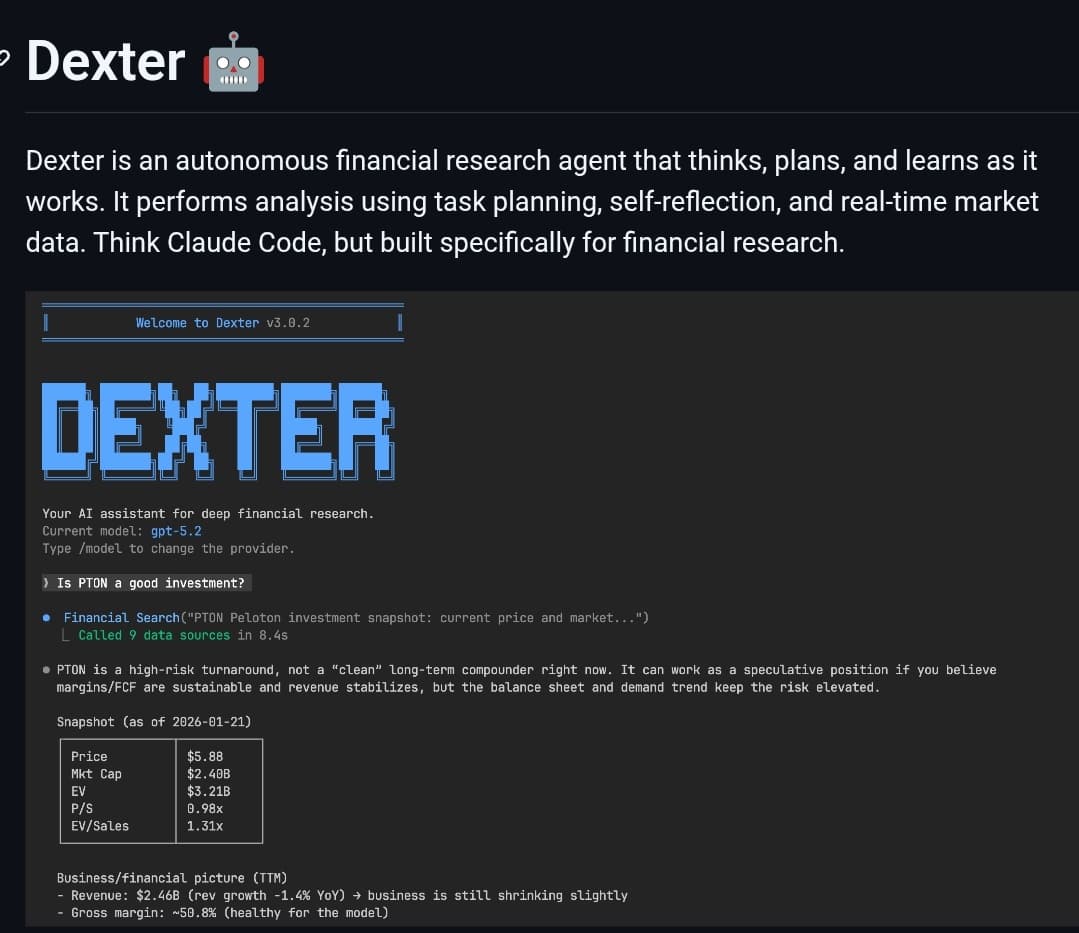
An open-source AI agent named Dexter autonomously conducts deep financial research, pulling real-time data, self-checking analysis, and iterating until confident. Described as 'Claude Code, but for finance,' it breaks down complex financial questions.

GAla Smith & AI Research Desk·Mar 17, 2026·2 min read·29 views·AI-Generated
Share:

What Happened

An autonomous AI agent named Dexter has been open-sourced on GitHub. The project, highlighted by the X account @_vmlops, is described as an agent that performs deep financial research autonomously.

According to the brief announcement, Dexter's stated capabilities include:

  • Breaking down complex financial questions.
  • Pulling real-time financial data.
  • Self-checking its own analysis.
  • Iterating on its research process until it reaches a confident conclusion.

The post draws a direct analogy to a known coding agent, framing it as: "Basically: Claude Code, but for finance."

Context

The release of Dexter fits into the rapidly growing category of specialized autonomous AI agents. While general-purpose coding assistants (like the referenced Claude Code) are common, agents tailored for specific, data-intensive domains like finance are less prevalent. The core promise is automating the research workflow—data gathering, synthesis, and analysis—which is typically manual and time-consuming.

Key open questions not addressed in the source material include the specific AI models powering the agent (e.g., GPT-4, Claude 3, open-source LLMs), the exact sources of its "real-time financial data," and its architecture for "self-checking" and iterative reasoning. The GitHub repository linked in the tweet would be the primary source for these technical details.

For practitioners, the significance lies in the open-source availability of a domain-specific agent blueprint, which could be adapted or studied for building similar systems in other verticals like legal research, market analysis, or scientific literature review.

Following this story?

Get a weekly digest with AI predictions, trends, and analysis — free.

AI Analysis

The Dexter announcement points to two significant, ongoing trends in applied AI. First, it represents the **verticalization of AI agents**. Moving beyond generalist chatbots, developers are building agents with baked-in domain knowledge (finance) and tool integrations (data APIs) to perform complete, multi-step workflows. The value isn't just in answering a question, but in autonomously executing the process a human analyst would follow: query formulation, data retrieval, cross-referencing, validation, and report synthesis. Second, the mention of "self-checks" and iteration touches on the critical challenge of **reliability and hallucination mitigation** in autonomous systems. A financial agent making incorrect inferences based on poor data or flawed logic has real-world consequences. The approach of building in self-critique loops—where the agent evaluates its own intermediate conclusions—is a recognized technique (e.g., Reflexion, AlphaCodium) to improve output robustness. The implementation details here would be key; a simple prompt-based check is different from a structured verification pipeline using separate classifiers or consistency checks. Practitioners should examine the Dexter repo for its **orchestration framework** (likely LangChain or LlamaIndex), its **tooling design** (how it interfaces with data providers like Bloomberg, SEC EDGAR, or Yahoo Finance), and its **reasoning mechanism** (whether it uses Chain-of-Thought, Tree-of-Thought, or a custom planner). Its performance will hinge on the quality of these components as much as the underlying LLM.
Enjoyed this article?
Share:

Related Articles

More in Products & Launches

View all