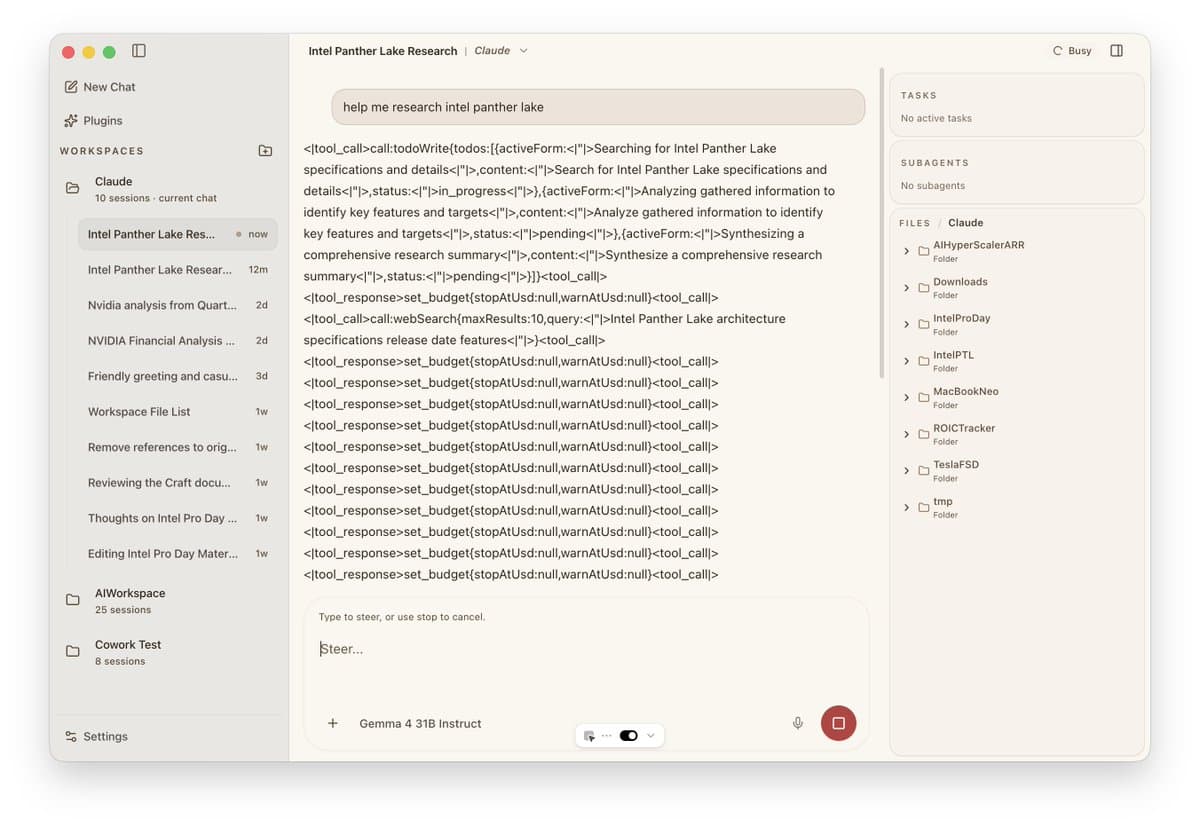
A developer's social media post has highlighted an intriguing, emergent behavior in Google's latest open-weight language model, Gemma 4. The user, @mweinbach, reported that while testing the model on a coding task, they witnessed it autonomously detect that it was caught in an infinite loop and subsequently terminate its own execution.
What Happened
In a post on X, @mweinbach shared their observation, stating, "This is actually super cool. Early Jinja errors whatever, but this is the first time I've EVER seen a google model notice it was in a loop and end itself." The user attached a video snippet showing the interaction, where the model's output stream appears to halt after generating repetitive code patterns, followed by a message indicating self-termination.
While the exact prompt and full context of the coding task are not detailed in the source, the core claim is specific: the model demonstrated an awareness of its own generative state—being stuck in a repetitive cycle—and took corrective action to stop. The user dismissed initial "Jinja errors" as irrelevant to the primary observation.
Context: The Challenge of AI Execution Control
For AI coding assistants and autonomous agents, a persistent challenge is managing execution flow and resource consumption. Models can easily generate code with infinite loops or get stuck in recursive reasoning chains, requiring external timeouts or user intervention to stop. The ability for a model to self-monitor and halt unproductive or erroneous processes is a step towards more robust and reliable autonomous systems.
Previous generations of models, including earlier Gemma versions and other coding-focused LLMs, typically lack this kind of meta-cognitive control. They will continue generating until a predefined token limit is reached or an external system kills the process.
What This Means in Practice
If this behavior is reproducible and can be intentionally engineered, it could lead to:
- More efficient AI agents: Agents that waste less compute time and API credits on fruitless tasks.
- Improved safety: Reduced risk of models getting stuck in harmful or nonsensical output loops.
- A new axis for evaluation: Beyond correctness, benchmarks could measure an AI's ability to recognize and recover from its own faulty execution paths.
gentic.news Analysis
This anecdotal report, while not a formal benchmark, points to a subtle but important evolution in reasoning capabilities. The core task here isn't just writing correct code—it's monitoring the process of writing code and applying a corrective policy. This aligns with a broader industry trend we've covered, such as in our analysis of OpenAI's o1 Model Family and the Shift to Process-Based Reasoning, where leading labs are explicitly training models to "think step-by-step" and verify their work. Google's Gemini series has also heavily emphasized reasoning, and this behavior in Gemma 4—its open-weight counterpart—suggests these architectural advances may be yielding unexpected, beneficial emergent properties.
However, caution is warranted. A single observation does not confirm a reliable capability. It could be a fortunate artifact of the specific prompt or a side effect of the model's refusal mechanisms. The critical next step is for researchers to design controlled experiments to test for and quantify this "self-termination on loop detection" ability. If proven, it would represent a meaningful, incremental advance in creating AI systems with better self-governance, moving beyond simple output generation towards managed execution—a necessary trait for truly autonomous agents.
Frequently Asked Questions
What is Gemma 4?
Gemma 4 is the latest iteration of Google's family of open-weight language models. Built from the same research and technology as the larger Gemini models, Gemma models are designed to be smaller, more efficient, and freely available for developers and researchers to use and build upon.
How could an AI model detect its own infinite loop?
Theoretically, a model could be trained or prompted to analyze its own recent output tokens for high levels of repetition or patterns indicative of a loop. Alternatively, this capability might emerge from reinforcement learning from human feedback (RLHF) or constitutional AI techniques that instill a general principle to "avoid unproductive output." The exact mechanism in Gemma 4 is not specified in this report.
Is this a common feature in other AI coding assistants?
No, this is reportedly the first time the observer has seen this behavior from a Google model. Mainstream AI coding tools like GitHub Copilot, Amazon CodeWhisperer, or even ChatGPT typically rely on external system-level timeouts or user commands to stop generation, rather than exhibiting intrinsic self-monitoring and termination.
Should developers now rely on AI to stop its own infinite code?
Absolutely not. This is a single, informal observation. For the foreseeable future, developers must implement robust external safeguards, timeouts, and code reviews when using AI-generated code. Treating this as a reliable feature would be a significant security and stability risk.