A development team recently detailed their Claude Code configuration that moves beyond basic prompting to a structured, multi-agent system. Their setup centers on one critical MCP server and a curated selection of skills that provide immediate workflow improvements without overwhelming complexity.
The Backbone: claude-flow MCP Server
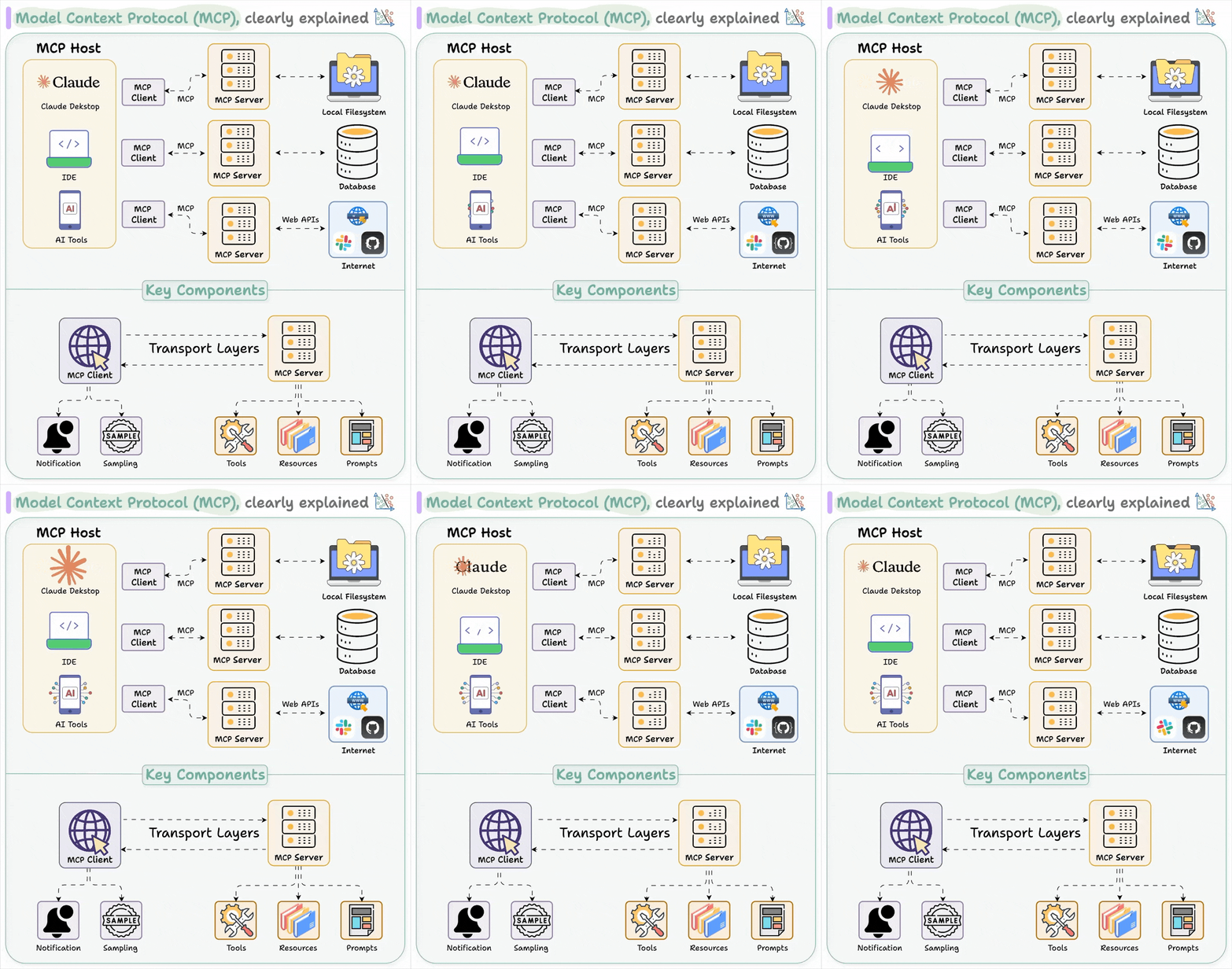
The entire system runs through claude-flow, an MCP server that orchestrates multiple Claude agents. This follows Anthropic's November 2024 introduction of the Model Context Protocol as an open standard for connecting AI systems to external tools and data sources.
Here's the exact configuration to add to your claude_desktop_config.json:
{
  "mcpServers": {
    "claude-flow": {
      "command": "npx",
      "args": ["-y", "@claude-flow/cli@latest", "mcp", "start"],
      "env": {
        "CLAUDE_FLOW_MODE": "v3",
        "CLAUDE_FLOW_HOOKS_ENABLED": "true",
        "CLAUDE_FLOW_TOPOLOGY": "hierarchical-mesh",
        "CLAUDE_FLOW_MAX_AGENTS": "15",
        "CLAUDE_FLOW_MEMORY_BACKEND": "hybrid"
      }
    }
  }
}
Install it directly with:
claude mcp add claude-flow -- npx -y @claude-flow/cli@latest mcp start
npx @claude-flow/cli@latest init --wizard
Key configuration choices that matter:
- hierarchical-mesh topology: Agents have a coordinator but can also communicate peer-to-peer. This avoids the bottlenecks of pure hierarchy while maintaining more structure than a pure mesh.
- hybrid memory: Combines fast in-memory storage with persistent disk-backed memory, allowing agents to remember patterns across sessions.
- 15 max agents: Their tested sweet spot where coordination overhead doesn't exceed parallelism benefits.
Start With These 3 Skills, Not 30
The team uses 30 skills but recommends starting with just three that provide the most immediate value:
sparc-methodology - Implements SPARC (Specification → Pseudocode → Architecture → Refinement → Completion). This adds structured development to what would otherwise be free-form AI coding.
swarm-orchestration - Enables parallel agent execution. Multiple Claude instances can work on different aspects of a problem simultaneously.
verification-quality - Automatically catches quality issues and can roll back changes that don't meet standards.
These skills are YAML-configured behaviors that extend Claude Code with domain-specific knowledge. Think of them as plugins that teach Claude how your team works.
The SuperClaude Command Chain
On top of the MCP and skills, they use SuperClaude slash commands that activate specialized behaviors. The power is in chaining them:
/sc:brainstorm "new user onboarding flow"
→ /sc:design (architecture from brainstorm output)
→ /sc:implement (code from design)
→ /sc:test (validate implementation)
→ /sc:analyze --focus security (security review)
→ /pr (commit, push, create PR)
Each command activates specific personas and tools. /sc:analyze might activate security, performance, and architecture personas simultaneously, each providing domain-specific feedback.
Enable Hooks for Self-Learning
The most advanced part of their setup is the hooks system. When CLAUDE_FLOW_HOOKS_ENABLED is set to "true", the system doesn't just automate—it learns from patterns in tool usage, code changes, and outcomes.
Key helper scripts in their hooks system:
- intelligence.cjs - Tracks patterns and learns which approaches work for which types of tasks
- learning-optimizer.sh - Adjusts model routing based on task complexity (simple tasks to faster models, complex tasks to Opus)
- security-scanner.sh - Runs after every edit, catching vulnerabilities before they reach git
What This Means for Your Workflow
This setup transforms Claude Code from a general-purpose coding assistant to a specialized engineering partner that understands your development patterns. The claude-flow MCP server, following the Model Context Protocol standard, provides the infrastructure for multi-agent coordination, while the three core skills add structure, parallelism, and quality control.
The hierarchical-mesh topology is particularly noteworthy—it represents a middle ground between completely decentralized agents (which can become chaotic) and rigid hierarchical structures (which create bottlenecks). This aligns with trends we've seen in multi-agent AI systems where coordination efficiency determines practical utility.
Start with the MCP server and three skills. Let the system run for a week, then consider adding the skill-builder meta-skill, which can create new skills from observed patterns in your workflow. That's where the real compounding begins: when your AI assistant learns from its own successes and stops repeating mistakes.