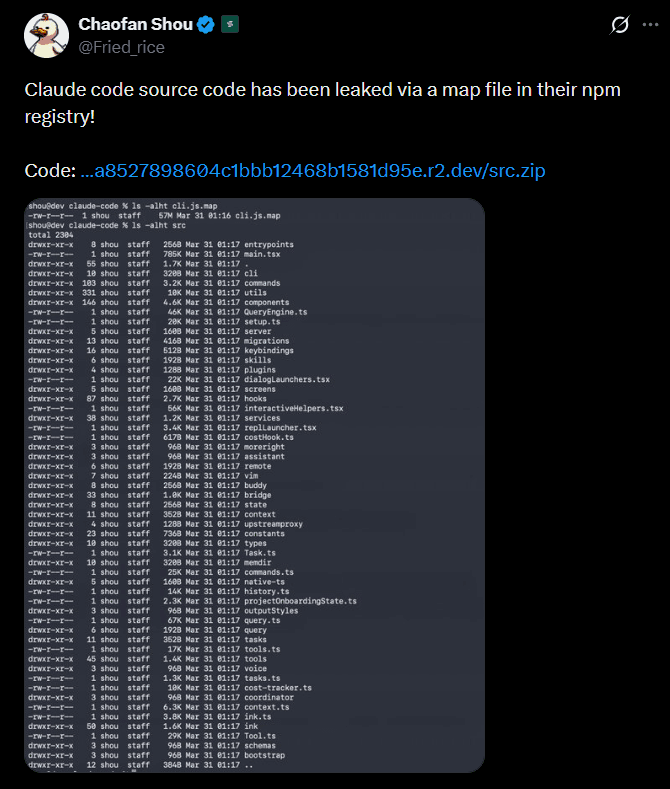
On March 31, 2026, a single missing line in a build configuration file led to one of the most significant accidental disclosures in AI engineering. Anthropic inadvertently published a 59.8 MB JavaScript source map file in version 2.1.88 of their @anthropic-ai/claude-code npm package. This file contained the entire, uncompiled TypeScript source code for Claude Code—nearly 2,000 files spanning over 512,000 lines. The leak provides a raw, unfiltered look at how a company with a reported $19 billion annualized revenue run-rate builds its flagship developer AI agent, revealing an architecture far more ambitious than its public-facing features suggest.
The Anatomy of an Accidental Leak
The root cause was deceptively simple: a missing *.map exclusion in the publish configuration. Source map (.map) files are JSON artifacts generated by bundlers to map minified, production-ready JavaScript code back to its original, human-readable source for debugging purposes. Crucially, the sourcesContent field within these maps often contains the entire original source code of every listed file, embedded verbatim. By publishing the package without excluding .map files, Anthropic shipped its entire source tree to the public npm registry.
The irony is structural. The leaked codebase itself contains a subsystem called Undercover Mode, engineered specifically to prevent Claude from leaking internal Anthropic information—like unreleased model codenames or project names—when contributing to public open-source repositories. The system that was built to guard secrets was itself exposed by a basic DevOps oversight, likely via the same build toolchain Claude Code uses.
What the Code Reveals: Beyond the CLI
Claude Code has been publicly positioned as an agentic command-line tool for developers. The leaked source reveals it is, in fact, a full-stack AI agent platform with several sophisticated, unannounced systems operating in concert.
The Multi-Agent Orchestration System
The code shows a coordinator mode that transforms Claude Code from a single agent into an orchestration layer. The system prompt explicitly teaches parallelism: workers run concurrently, communicate via structured messages, and share state through a gated scratchpad. It includes guardrails against "lazy delegation," instructing the coordinator to "read the actual findings and specify exactly what to do." The platform supports creating agent swarms with in-process and process-based teammates, complete with team memory synchronization and visual distinction in the terminal—hallmarks of production engineering, not research prototypes.
KAIROS: Proactive Background Agency
KAIROS is a persistent background mode where Claude Code operates proactively without waiting for user input. It watches, logs, and acts based on append-only daily logs and periodic "tick" prompts. A key design principle is user flow preservation: any action that would interrupt the user is given a 15-second blocking budget; actions exceeding it are deferred. The system includes a "Brief" output mode for extremely concise responses, reflecting a mature understanding that a verbose background agent would not survive user tolerance.
ULTRAPLAN: Offloaded Long-Horizon Reasoning
For complex tasks, Claude Code can delegate planning to a remote cloud container running Claude Opus 4.6, granting it up to 30 minutes of reasoning time. The local terminal polls for results every three seconds, while a browser-based UI allows the user to observe, approve, or reject the plan. This mirrors enterprise human-in-the-loop approval flows, integrated directly into a developer CLI.
The Dream System: Autonomous Memory Management
A subsystem called autoDream handles background memory consolidation. It runs as a forked subagent—isolated from the main agent's context—and is triggered by a three-gate system (time, session count, and a consolidation lock). It then runs four phases: orient, gather, consolidate, and prune, maintaining a clean, high-signal context under 25KB for future sessions. This isolation principle is akin to database vacuuming, preventing the main agent's context from being contaminated by its own maintenance operations.
The Immediate Aftermath and Community Reaction
The technical community's response was swift. The code was archived across GitHub within hours. Notably, developer Kuber Mehta built claurst—a clean-room Rust reimplementation of Claude Code’s behavior, reverse-engineered from specifications derived from the leak without copying the original TypeScript. The project quickly garnered 4.9k stars and 5.9k forks, signaling intense developer appetite to understand how such systems are built.
The incident was compounded by a coinciding supply-chain attack on the popular axios package during the same deployment window, expanding the blast radius for teams running npm install that morning. Anthropic has since pulled version 2.1.88 from the npm registry, but the codebase is permanently mirrored across the internet.
Retail & Luxury Implications: The Agentic Future of Operations
While Claude Code is a developer tool, the architectural patterns revealed in its leak are directly instructive for retail and luxury brands building their own AI agent ecosystems. The leak is a masterclass in production-grade agent design.
1. Multi-Agent Orchestration for Complex Workflows: The coordinator and swarm patterns are directly applicable to retail operations. Imagine a system where one agent analyzes real-time sales data, another monitors global supply chain alerts, and a third drafts inventory reallocation plans—all orchestrated by a central coordinator that ensures coherent, parallel execution. This moves beyond simple chatbots to autonomous workflow optimization.
2. Proactive, Background Intelligence (KAIROS): The KAIROS pattern—acting proactively within strict user-flow budgets—is crucial for internal enterprise tools. A background agent could monitor competitor pricing, social sentiment, or logistics delays, delivering ultra-concose, actionable alerts only when a defined threshold is crossed, without disrupting a merchant's workflow.
3. Isolated Subsystems for Maintenance (The Dream System): The principle of forking subagents for maintenance tasks like memory consolidation is a vital lesson for building stable, long-running retail AI systems. Customer profile enrichment, trend analysis from past seasons, or compliance log auditing could be handled by isolated, scheduled subagents, keeping the primary customer-facing or planning agents clean and responsive.
4. Human-in-the-Loop for High-Stakes Decisions (ULTRAPLAN): The ULTRAPLAN pattern of offloading complex reasoning (e.g., planning a global marketing campaign or a major inventory shift) to a more powerful, remote model with a human approval step is a robust template for high-value, strategic retail decisions where accountability is paramount.
The leak also serves as a stark warning on AI supply-chain security. A simple config error in a core tool can expose critical IP. For luxury houses leveraging third-party AI agent platforms or building their own, rigorous publish/deploy gating and software bill of materials (SBOM) management are non-negotiable.
gentic.news Analysis
This leak arrives at a pivotal moment for Anthropic and the AI agent landscape. According to our Knowledge Graph, industry leaders had already predicted 2026 as a breakthrough year for AI agents, and this incident underscores both the rapid maturity and the operational risks of this technology. Anthropic, which our data shows is projected to surpass OpenAI in annual recurring revenue by mid-2026 and is considering an IPO as soon as October 2026, now faces a unique challenge: its most advanced agent engineering secrets are public domain just as it seeks to solidify its market position.
The leak reveals that Claude Code is not just a tool but a foundational platform, leveraging Claude Opus 4.6 (Anthropic's most capable model, released in February 2026) for its most demanding tasks like ULTRAPLAN. This aligns with the broader competitive trend we've covered, where AI companies are bundling top-tier model access into specialized products, as seen in Glass AI's bundling of Claude Opus 4.6, GPT-5.4, and Gemini 3.1 Pro.
Furthermore, the incident's nature—a supply-chain exposure—echoes a concerning trend we reported on just days prior: the Mercor AI data breach that exposed 4TB of data via a LiteLLM supply-chain attack, impacting both OpenAI and Anthropic. For technical leaders in retail, these back-to-back events highlight that the AI toolchain itself is becoming a critical attack surface. Building or integrating advanced agents requires a security-first posture that extends deep into the DevOps pipeline.
Ultimately, the Claude Code leak is a double-edged sword for the industry. It provides an invaluable, open-source textbook on building reliable, multi-agent systems at scale—knowledge that will accelerate agent development across sectors, including retail. However, it also demonstrates that even the most sophisticated AI engineering organizations are vulnerable to simple human error, a sobering reminder for any enterprise betting its future on autonomous AI systems.