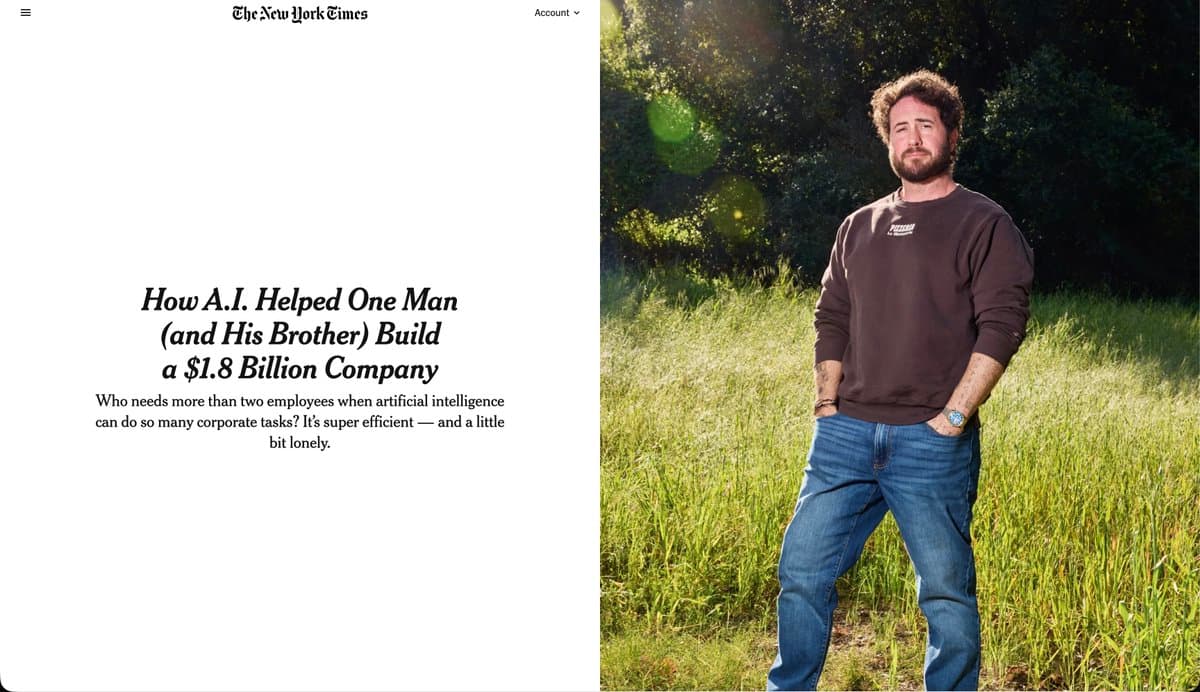
A new benchmark for AI-enabled entrepreneurship has been set. According to a report from AI analyst Lior S., Matthew Gallagher launched the GLP-1 telehealth provider Medvi entirely from his Los Angeles home, leveraging AI tools across core business functions. The venture reached $300,000 in revenue in its first month, $1 million in its second month, and scaled to a staggering $401 million in its first full year of operation.
Gallagher has since hired his brother, Elliot Gallagher, as the company's first and only employee. The two-person operation is now on track to generate $1.8 billion in revenue this year (2026), establishing a new archetype for the capital-efficient, AI-native startup.
What Happened: The AI-Powered Launch
The core narrative is one of extreme leverage. Gallagher did not build a large founding team or a complex internal tech stack from scratch. Instead, he used commercially available AI tools to handle three critical early-stage business functions:
- Website Copy: AI-generated marketing and service copy.
- Customer Videos: AI-assisted creation of explanatory or promotional video content.
- Business Analytics: AI-driven data analysis to inform strategy and growth decisions.
This tooling allowed a single individual to act as product developer, marketer, and data analyst simultaneously, compressing the startup launch timeline and minimizing initial burn rate. The company operates in the high-demand GLP-1 agonist telehealth space, providing access to medications like semaglutide (Ozempic, Wegovy) and tirzepatide (Mounjaro, Zepbound) through digital consultations.
The Growth Trajectory
The reported growth metrics are unprecedented for a founder-led startup of this scale:
Month 1 $300,000 Launch month from LA home. Month 2 $1,000,000 233% month-over-month growth. First Full Year $401,000,000 Annualized run rate. Projected 2026 $1,800,000,000 Forecast with 2 total employees.This trajectory suggests Medvi capitalized on explosive demand for GLP-1 medications, with AI tools enabling Gallagher to scale operations and customer acquisition without a proportional increase in human headcount.
The "One-Person Billion-Dollar Company" Framework
The story validates a thesis increasingly discussed in tech circles: that AI can collapse traditional startup scaling functions—marketing, content, data, customer support—into a workflow manageable by a single product-oriented founder. The "one-person billion-dollar company" is not a company with one person forever, but one where a solo founder can achieve product-market fit and massive initial scale before needing to build a traditional organization.
Medvi's subsequent hiring of a single employee (a family member) further emphasizes a model of extreme selectivity and capital allocation, where revenue funds growth and technology handles scalability.
gentic.news Analysis
This case study is the most concrete, high-fidelity example to date of the "AI Solo Founder" thesis moving from theory to reality. It directly follows the trend we identified in our 2025 coverage of "Solopreneur AI Stacks," where tools like Cognition's Devin, OpenAI's o1 models, and Cline were enabling individual developers to build complex applications. Medvi demonstrates this principle applied not to SaaS, but to a regulated, logistics-heavy sector like telehealth.
The growth metrics, if accurate, suggest Medvi is capturing a significant slice of the direct-to-consumer GLP-1 market, a space currently contested by well-funded players like Hims & Hers, Ro, and WeightWatchers Sequence. Gallagher's AI-first, capital-light approach provided a velocity advantage over these larger, more bureaucratic incumbents. This aligns with our analysis of Founder+AI as a competitive moat, where a founder's deep market insight, combined with AI execution, can outmaneuver traditional venture-scale startups.
However, key questions remain unanswered in the initial report. The specific AI tools used are not named, making technical replication difficult. Furthermore, the long-term sustainability of a two-person team managing a multi-billion dollar patient-facing healthcare operation is untested. Scaling compliance, patient safety protocols, and pharmacy network management typically requires specialized human teams. Medvi's next phase will test whether AI can manage not just growth, but the complex, risk-intensive operations of a healthcare provider at scale. This story is less about the end of hiring and more about a profound shift in the initial velocity and capital efficiency AI grants to insightful founders.
Frequently Asked Questions
What AI tools did Medvi use?
The original report does not specify the exact AI tools Matthew Gallagher used for website copy, customer videos, and business analytics. Based on the 2025-2026 market landscape, plausible candidates for these functions include AI writing assistants like Copy.ai or Jasper for copy, video generation platforms like Synthesia or HeyGen for customer videos, and analytics tools like Akkio or Power BI with Copilot for data analysis. The key takeaway is the use of integrated, off-the-shelf SaaS AI tools rather than proprietary models.
How can a two-person company handle healthcare compliance?
This is the central operational question for Medvi's model. The company likely relies heavily on third-party vendors and software to manage compliance (HIPAA), pharmacy fulfillment, and licensed medical oversight. Gallagher's role would be to architect and manage these vendor relationships and AI-driven workflows, rather than perform regulated tasks personally. The model assumes compliance can be "bought" via API and vendor contracts, not built in-house.
Is Medvi's revenue projection of $1.8B realistic?
Given its reported first-year revenue of $401 million in the explosively growing GLP-1 market, a projection to ~$1.8B in year two represents a growth factor of ~4.5x. This is aggressive but not implausible for a company capturing market share in a sector with immense demand. The projection's credibility hinges on Medvi's customer acquisition cost efficiency and its ability to maintain high margins while scaling through vendor networks, not direct employee hires.
What does this mean for traditional venture capital?
The Medvi case demonstrates that founders with deep domain expertise can now reach massive scale with minimal initial capital. This potentially reduces early dependence on venture funding and shifts VC leverage to later stages for scaling operations, M&A, or regulatory battles. VCs may need to focus on founders who are exceptional at leveraging AI tools, not just those with large pre-built teams.