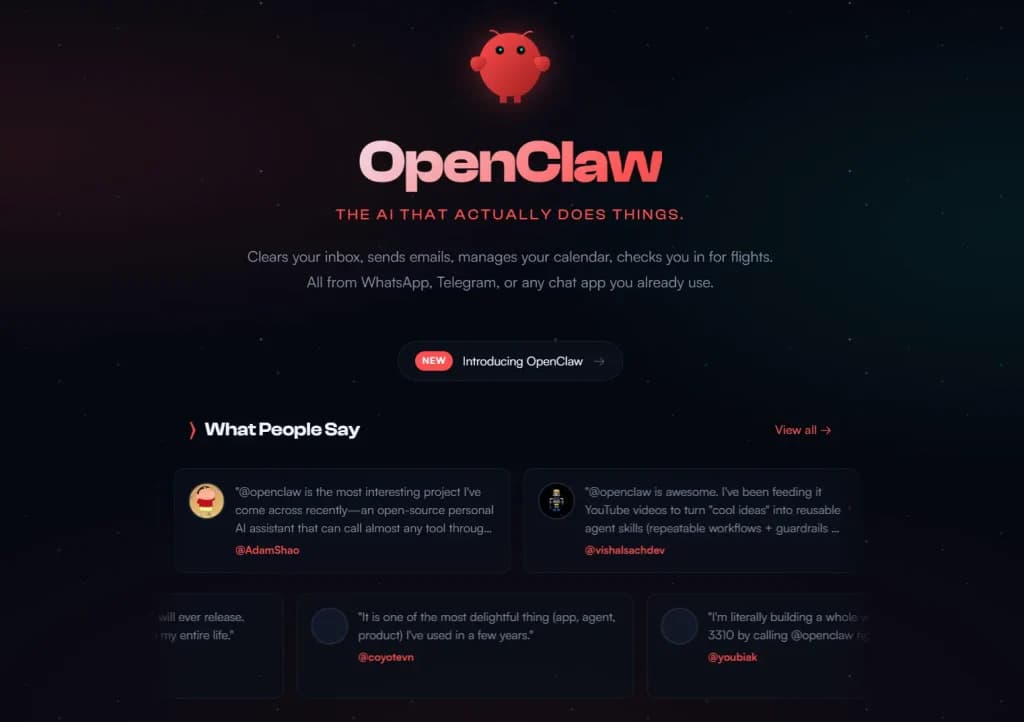
Developers have released a free, open-source alternative to Anthropic's Claude Cowork, positioning it as a fully local, extensible desktop AI assistant. The project, highlighted in a social media post, claims to replicate and extend core features of the commercial offering while removing cloud dependencies and costs.
What's New
The tool is described as a direct, feature-competitive alternative to Claude Cowork, Anthropic's integrated AI workspace. Its stated feature set includes:
- 100% Local Operation: All processing, including likely voice and agent workflows, occurs on the user's device. This addresses privacy, cost, and latency concerns associated with cloud-based APIs.
- Voice Interface: Native voice-enabled interaction, a feature central to the Claude Cowork experience.
- LLM Agnosticism: Can be configured to work with any large language model, presumably via local inference (e.g., using Ollama, LM Studio) or by connecting to various API endpoints.
- Model Context Protocol (MCP) Extensibility: Integrates with the open Model Context Protocol, allowing the assistant to connect to databases, filesystems, and other tools—a key feature of the Claude platform.
- Obsidian-Compatible Vault: Can integrate with or manage knowledge in Obsidian's markdown-based vault system, bridging AI assistance with personal knowledge management.
- Background Agents & Web Search: Supports persistent, automated agentic workflows and live web search capabilities.
- Automatic Knowledge Graph Creation: Analyzes user content to dynamically build a connected knowledge graph, enhancing context and recall.
The project is fully open-source, with code publicly available for inspection, modification, and distribution.
Technical Implications
This launch represents a continuation of the trend to democratize and localize advanced AI assistant capabilities. By combining MCP (a protocol pioneered by Anthropic but made open for broader use) with local LLM execution, the project decouples powerful AI workspace features from a specific vendor's cloud and model lineup. The focus on Obsidian compatibility directly targets a technically sophisticated user base already invested in structured note-taking, suggesting a design philosophy centered on user sovereignty and data ownership.
The ability to use "any LLM" shifts the competitive focus from the model provider to the interface and agent framework. Users could pair this tool with a local Llama 3.2 model, a paid GPT-4 API, or Claude itself, making the assistant layer a neutral platform.
Limitations & Considerations
As an early-stage open-source project, its polish, stability, and ease of setup are unproven compared to a commercial product like Claude Cowork. Performance will be heavily dependent on the user's local hardware, especially for voice processing and running larger local models. The integration and management of multiple tools and agents locally presents a significant technical complexity that the project must abstract away to achieve broad adoption.
gentic.news Analysis
This development is a tactical response in the ongoing platform war for AI developer and power-user mindshare. Anthropic's introduction of Claude Cowork and its embrace of the open MCP standard was a strategic move to create an ecosystem lock-in at the workspace level, not just the model level. This open-source alternative directly challenges that by offering the same conceptual workspace—voice, agents, tools, knowledge graphs—but on a user-controlled, vendor-agnostic foundation.
It follows a pattern we've tracked closely: the rapid commoditization of AI infrastructure. First, open-source models (like Meta's Llama series) pressured closed model APIs. Now, the battle is moving to the orchestration and interface layer. This project, by stitching together local inference, an open tool protocol (MCP), and a popular PKM system (Obsidian), exemplifies how the open-source community can reassemble proprietary stacks with interchangeable parts.
For practitioners, the key takeaway is the validation of the "local-first, model-agnostic AI assistant" as a viable category. It creates leverage: developers can build workflows and tools against this open platform without fear of vendor pricing changes or product deprecation, while users retain full data control. The major hurdle remains user experience; the convenience of a seamless, cloud-managed service like Claude Cowork is a high bar for a community-driven project to clear.
Frequently Asked Questions
What is Claude Cowork?
Claude Cowork is Anthropic's integrated AI workspace application that combines chat, voice interaction, tool use via MCP, and project-based context in a single desktop interface. It's designed as a persistent AI assistant for complex tasks.
How can this alternative be "100% local" and still do web search?
The "100% local" claim primarily refers to LLM inference and data processing. Features like web search would still require an outbound internet connection to fetch information, but the processing and decision to perform a search would be handled locally, unlike a cloud service where the entire reasoning chain might occur on remote servers.
What are MCP tools?
The Model Context Protocol (MCP) is an open protocol developed by Anthropic that allows AI models to connect to external tools, data sources, and services (like databases, file systems, or APIs). It's a standardized way for an AI to "use" software, and its openness means tools built for Claude can potentially work with other MCP-compatible applications, like this open-source alternative.
Is this project ready for non-technical users?
Based on its early open-source status and feature set, it is likely targeted at developers, researchers, and technical enthusiasts comfortable with configuring local LLM servers, setting up tool connections, and managing software dependencies. It is not a consumer-grade, one-click install competitor to Claude Cowork at this stage.