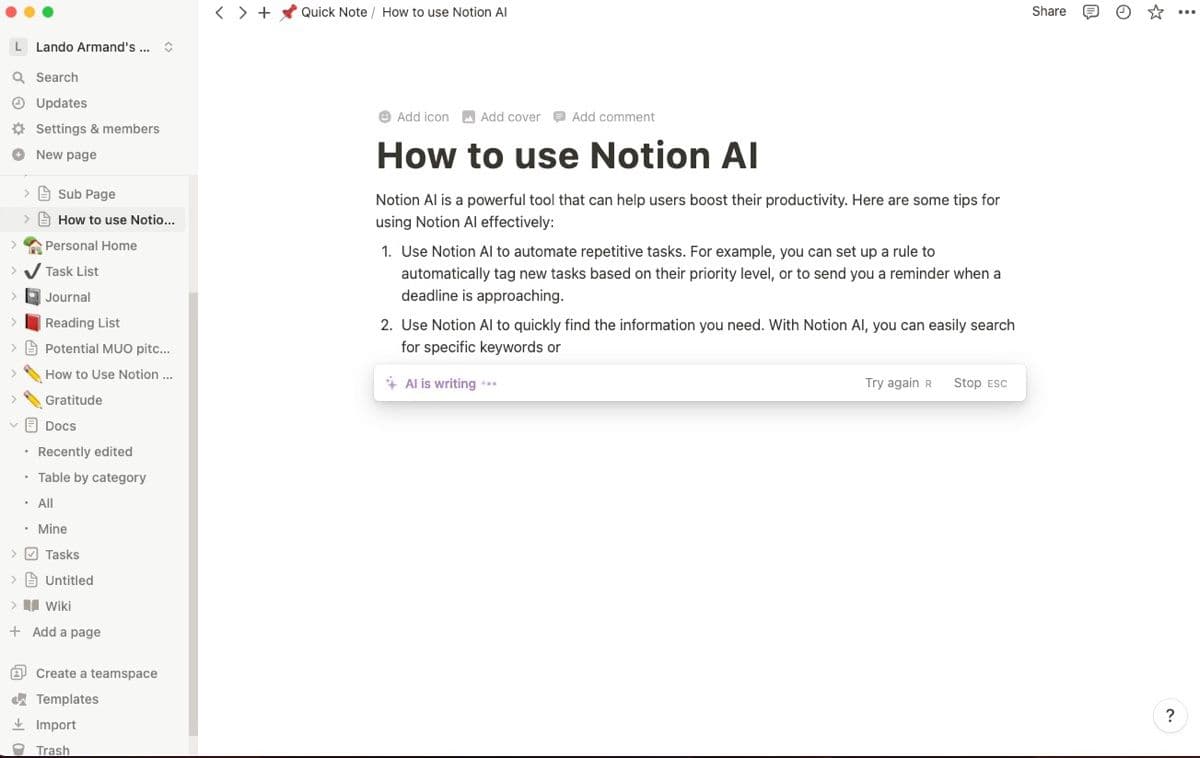
A PhD researcher has publicly claimed to have deleted Notion, their note-taking application, and their inbox triage tool, replacing all of them with a single, custom AI agent they refer to as "Muse." The announcement was made via a social media post, framing it as a radical consolidation of personal productivity infrastructure.
What Happened
The claim is straightforward: an individual researcher has built or configured an AI agent capable of handling the core functions of three distinct categories of software:
- Project & Knowledge Management (Notion): Organizing notes, databases, and project plans.
- Ad-hoc Note-Taking: Capturing quick thoughts, ideas, and meeting notes.
- Email/Inbox Triage: Sorting, prioritizing, and potentially drafting responses to incoming messages.
The agent, dubbed "Muse," presumably uses a large language model (LLM) as its reasoning engine, connected to a vector database for personal knowledge retrieval and equipped with tools to interact with email APIs and other data sources. The researcher's post suggests this integration has reached a level of reliability and utility that allows them to abandon the dedicated graphical user interfaces of the former tools.
Context & The AI-Agent Trend
This anecdote is a microcosm of a significant shift in human-computer interaction, moving from using multiple, siloed applications to interacting with a single, conversational AI interface that can orchestrate tasks across domains. The vision of an AI "operating system" or a central agent that manages all digital work is a common theme in AI research and venture investment.
Practically, building such an agent involves:
- A capable LLM (e.g., GPT-4, Claude 3, or open-source models like Llama 3) for reasoning and language understanding.
- A retrieval-augmented generation (RAG) system that indexes the user's entire history of notes, documents, and emails, allowing the AI to reference personal context.
- Tool use/function calling to perform actions like creating calendar events, sending emails, or saving notes to a database.
- A persistent memory or state management system to maintain context across conversations and tasks.
While companies like Google (with Gemini Advanced) and Microsoft (with Copilot) are pushing integrated AI assistants, this example points to a user-built, highly personalized alternative that replaces specific commercial tools entirely.
gentic.news Analysis
This user report, while anecdotal, is a tangible data point in the accelerating trend of AI-agentification of personal workflow. It's not about an AI helper within Notion or Gmail; it's about an AI that replaces them by abstracting their functions into API calls and natural language commands. This aligns with the direction of research into Agent AI and AI OS, a space where startups like Cognition Labs (with its AI software engineer, Devin) and Sierra are building towards general-purpose agentic interfaces.
The move also highlights a growing confidence among technical users to architect their own AI-centric systems, leveraging powerful foundational models available via API. This DIY approach bypasses the often-slower integration cycles of large software vendors. However, it raises immediate questions about data portability, security, and long-term maintenance. If "Muse" is a custom script built around an OpenAI or Anthropic API, the researcher is now locked into that stack and responsible for its upkeep—a trade-off for total control.
From a market perspective, this is a warning shot for SaaS productivity tools that rely on user lock-in through data and habit. Their moat may erode if a sufficiently intelligent agent can extract, structure, and act on that data from the outside. The next logical step, which some startups are already pursuing, is to productize this "Muse" concept into a configurable personal agent platform.
Frequently Asked Questions
What is an AI agent like "Muse"?
An AI agent is a system that uses a large language model to perceive its environment (e.g., your emails, notes, calendar), make decisions, and take actions to achieve goals (e.g., "summarize my week," "draft a response to this client," "find my notes from the Q3 planning meeting"). Unlike a simple chatbot, it has access to tools and persistent memory.
How could an AI agent replace Notion?
It would replace the interface, not necessarily the storage. The agent would likely manage a backend database (like a vector store or SQL database) that holds all the information you'd normally put in Notion. Instead of clicking and typing into Notion's UI, you would tell the agent, "Add a new page to my research project with the following notes," or "Pull up the timeline for project X." The agent handles the data structuring and retrieval.
Is this practical for non-technical users?
Currently, no. Building a robust, reliable, and secure personal AI agent requires significant technical expertise in programming, API integration, and system design. However, the trend is clearly towards commercial products (like advanced versions of Microsoft Copilot or new startups) that will offer pre-built, user-friendly versions of this capability in the coming years.
What are the biggest risks of relying on a custom AI agent?
The primary risks are vendor lock-in (if built on a specific LLM API), data loss or corruption (if the custom system has a bug), security vulnerabilities (if the agent has broad access to emails and accounts), and maintenance burden (the user becomes their own IT department, updating code as APIs change).