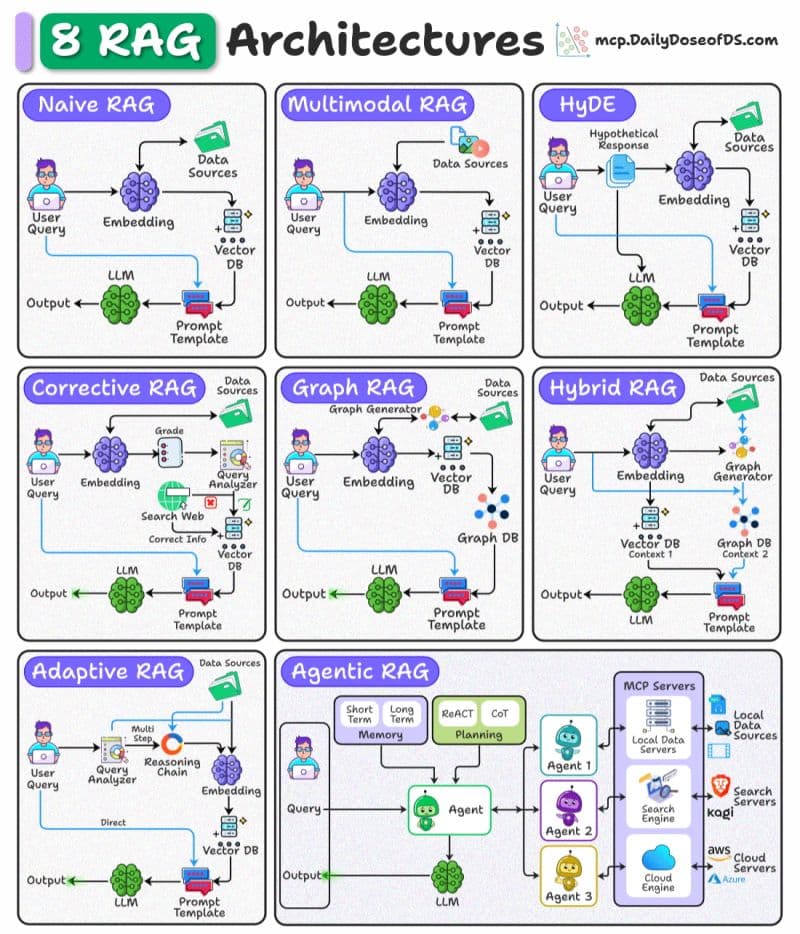
A detailed technical breakdown circulating among AI practitioners categorizes eight distinct Retrieval-Augmented Generation (RAG) architectures, each with specific use cases and implementation considerations. This framework provides engineers with a practical decision matrix for choosing the right retrieval approach based on query complexity, data types, and accuracy requirements.
What Are the Eight RAG Architectures?
The classification organizes RAG systems along a complexity spectrum, from simple semantic matching to sophisticated agentic workflows:
1) Naive RAG
- Mechanism: Retrieves documents purely based on vector similarity between query embeddings and stored embeddings
- Best For: Simple, fact-based queries where direct semantic matching suffices
- Limitations: Struggles with complex reasoning, multi-hop queries, or queries where the question phrasing differs significantly from answer phrasing
2) Multimodal RAG
- Mechanism: Handles multiple data types (text, images, audio, etc.) by embedding and retrieving across modalities
- Best For: Cross-modal retrieval tasks like answering a text query with both text and image context
- Implementation: Requires unified embedding spaces or cross-modal alignment techniques
3) HyDE (Hypothetical Document Embeddings)
- Mechanism: Generates a hypothetical answer document from the query before retrieval, then uses this generated document's embedding to find relevant real documents
- Best For: Queries where the question phrasing isn't semantically similar to the answer documents
- Example: Query "How do I fix a leaky faucet?" generates hypothetical repair instructions, then retrieves actual plumbing manuals
4) Corrective RAG
- Mechanism: Validates retrieved results by comparing them against trusted sources (e.g., web search, verified databases)
- Best For: Ensuring up-to-date and accurate information, filtering or correcting retrieved content before passing to the LLM
- Implementation: Adds verification layer that can cross-reference multiple sources
5) Graph RAG
- Mechanism: Converts retrieved content into a knowledge graph to capture relationships and entities
- Best For: Enhancing reasoning by providing structured context alongside raw text to the LLM
- Advantage: Enables relationship-based queries ("What companies did this founder start after Company X?")
6) Hybrid RAG
- Mechanism: Combines dense vector retrieval with graph-based retrieval in a single pipeline
- Best For: Tasks requiring both unstructured text and structured relational data for richer answers
- Implementation: Typically uses weighted combination of vector and graph retrieval scores
7) Adaptive RAG
- Mechanism: Dynamically decides if a query requires simple direct retrieval or multi-step reasoning chain
- Best For: Breaking complex queries into smaller sub-queries for better coverage and accuracy
- Decision Making: Uses classifier or heuristics to route queries to appropriate retrieval strategy
8) Agentic RAG
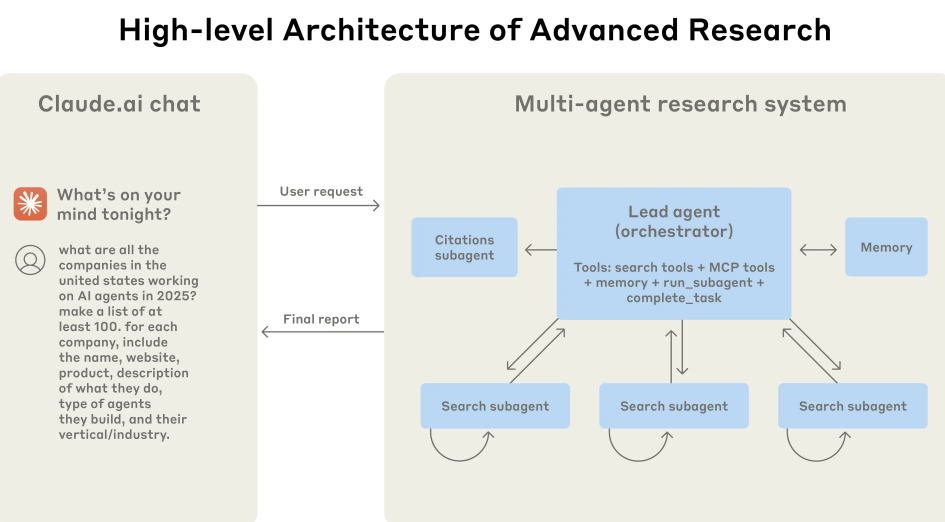
- Mechanism: Uses AI agents with planning, reasoning (ReAct, CoT), and memory to orchestrate retrieval from multiple sources
- Best For: Complex workflows requiring tool use, external APIs, or combining multiple RAG techniques
- Capabilities: Can chain multiple retrievals, synthesize information, and execute actions based on retrieved knowledge
Practical Implementation Considerations
When to Choose Which Architecture
Simple factual lookup Naive RAG Fastest implementation, lowest latency Cross-modal queries Multimodal RAG Requires multimodal embedding alignment Mismatched query/answer phrasing HyDE Adds generation step before retrieval High accuracy requirements Corrective RAG Adds verification overhead Relationship-heavy queries Graph RAG Requires knowledge graph construction Mixed structured/unstructured data Hybrid RAG Combines multiple retrieval systems Variable complexity queries Adaptive RAG Needs query classification system Complex multi-step workflows Agentic RAG Highest complexity, most flexiblePerformance Trade-offs
Each architecture introduces specific trade-offs:
- Latency: Naive RAG offers lowest latency; Agentic RAG introduces multiple reasoning steps
- Implementation Complexity: Naive RAG is simplest to implement; Agentic RAG requires full agent framework
- Accuracy: Simple architectures may miss nuanced relationships; complex architectures improve accuracy at cost of speed
- Maintenance: More complex systems require more monitoring, testing, and updating
What This Means for AI Engineers
This classification provides a valuable mental model for system design decisions. Rather than treating RAG as a monolithic technique, engineers can now:
- Match architecture to use case: Choose the simplest architecture that meets accuracy requirements
- Plan evolution paths: Start with Naive RAG and add complexity only when needed
- Communicate design decisions: Use this shared vocabulary when discussing system architecture
- Benchmark appropriately: Compare systems within the same architectural category
gentic.news Analysis
This taxonomy arrives at a critical inflection point in RAG adoption. According to our coverage of the 2025 RAG Survey by LlamaIndex, over 72% of production AI systems now incorporate some form of retrieval augmentation, up from just 38% in early 2024. However, the same survey revealed that 64% of teams struggle with "RAG architecture selection paralysis"—uncertainty about which approach to implement for their specific use case.
This framework directly addresses that pain point by providing clear decision boundaries. The progression from Naive to Agentic RAG mirrors the broader industry trend we've documented: systems are evolving from simple retrieval bolted onto LLMs toward sophisticated reasoning architectures where retrieval is just one component of an intelligent workflow.
Notably, the inclusion of Agentic RAG as the most complex category aligns with our December 2025 analysis of the agent framework market, which showed a 300% year-over-year growth in agent orchestration platforms. Companies like LangChain, LlamaIndex, and CrewAI have been building precisely toward this vision of multi-step, tool-using retrieval systems. The relationship between these frameworks and the architectures described here is direct: most agent frameworks now include built-in support for several of these RAG patterns.
What's particularly valuable about this breakdown is its practical orientation. Unlike academic taxonomies that focus on theoretical distinctions, this framework emphasizes usage patterns—telling engineers not just what each architecture is, but when to use it. This bridges the gap between research papers and production code, a gap that our readers consistently identify as their biggest challenge.
Frequently Asked Questions
Which RAG architecture should I start with for a new project?
Start with the simplest architecture that meets your accuracy requirements. For most initial implementations, Naive RAG with a well-tuned embedding model and chunking strategy provides 80-90% of the value with minimal complexity. Only add architectural complexity (like HyDE or Adaptive RAG) when you encounter specific failure modes that simpler approaches can't address. This aligns with the "simplest viable architecture" principle that successful AI engineering teams follow.
How do I know when to upgrade from Naive RAG to a more complex architecture?
Monitor specific failure patterns. If users consistently ask questions where the phrasing doesn't match answer documents, consider HyDE. If you need to verify facts against external sources, implement Corrective RAG. If queries involve relationships between entities, explore Graph RAG. The key is to let actual usage patterns—not theoretical advantages—drive architectural evolution. Instrument your system to track query types, retrieval failures, and accuracy gaps.
What's the performance overhead of more complex RAG architectures?
Complexity introduces latency, cost, and maintenance overhead. Agentic RAG can be 5-10x slower than Naive RAG due to multiple LLM calls and tool executions. Corrective RAG adds external API calls. Graph RAG requires knowledge graph construction and maintenance. The trade-off is accuracy: complex architectures typically achieve 15-40% higher accuracy on challenging queries. Benchmark your specific use case to determine if the accuracy improvement justifies the performance cost.
Are there production frameworks that implement these architectures?
Yes, most modern LLM frameworks support multiple RAG patterns. LlamaIndex has built-in support for Hybrid, Graph, and Adaptive RAG. LangChain's agent system enables Agentic RAG. Haystack supports Corrective RAG through its validation components. The ecosystem has matured significantly since 2024, with most frameworks now offering modular components that can be combined to implement these architectures rather than requiring custom implementations from scratch.