What Happened
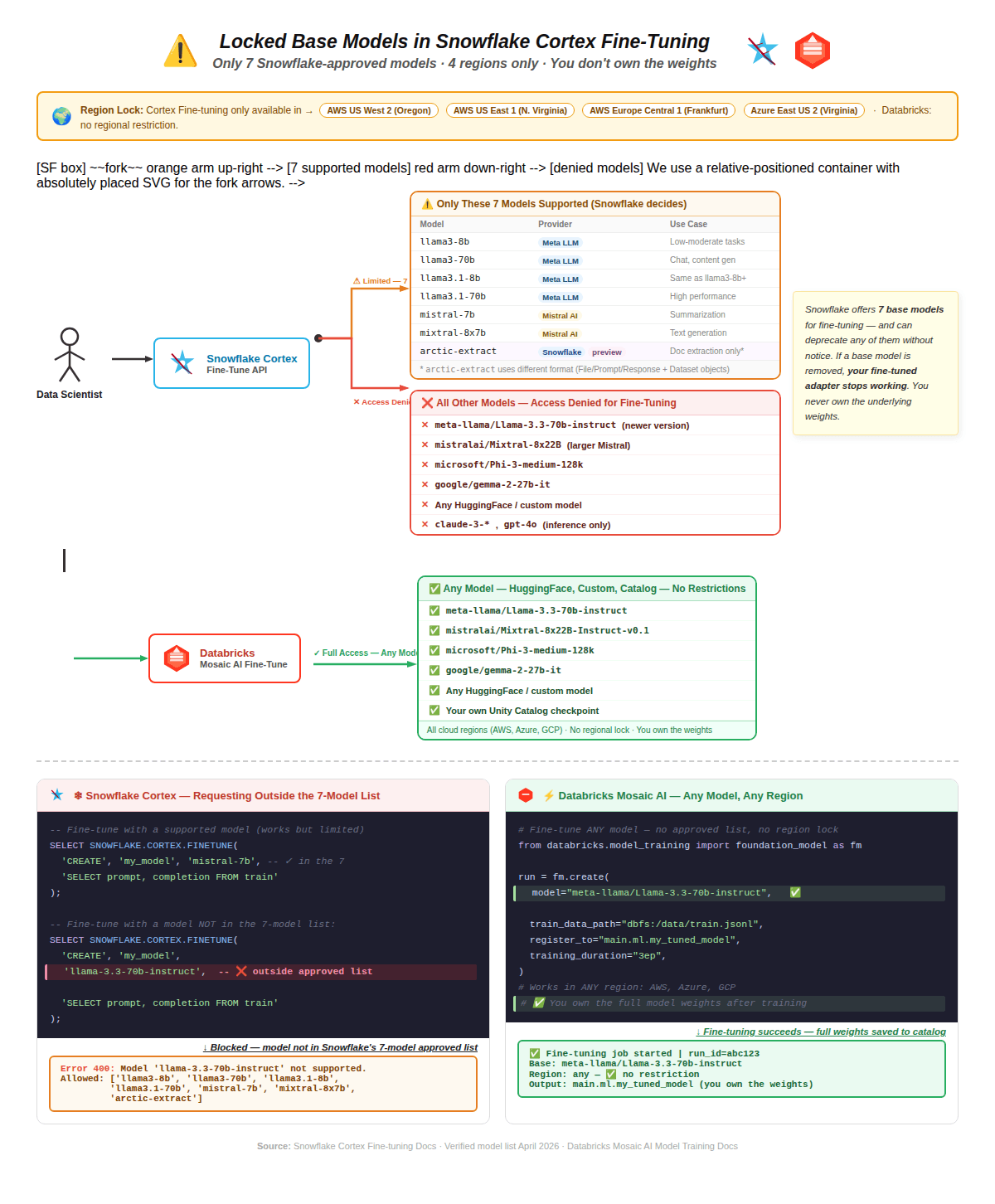
A technical practitioner has published a hands-on, comparative analysis of fine-tuning large language models (LLMs) on two of the most prominent enterprise data platforms: Snowflake Cortex and Databricks. The article, hosted on Medium, promises an "honest breakdown" of what the AI fine-tuning workflow actually entails on each platform, based on direct testing and documentation. While the full details are behind Medium's paywall, the premise is clear: this is a practical, implementation-focused guide comparing the developer experience, capabilities, and likely the cost and complexity of performing a foundational AI task—model customization—within these competing ecosystems.
Technical Details: The Fine-Tuning Landscape
Fine-tuning is the process of taking a pre-trained, general-purpose LLM (like Llama 3 or Mistral) and further training it on a specialized, domain-specific dataset. This adapts the model's knowledge and response style to a particular task, such as generating product descriptions in a brand's tone, classifying customer service intent with high accuracy, or summarizing complex internal reports. It sits on a spectrum of customization techniques between simpler prompt engineering and more complex retrieval-augmented generation (RAG) systems.
As noted in our related coverage, a recent Medium guide titled "When to Prompt, RAG, or Fine-Tune" provided a decision framework for this exact choice. Fine-tuning is typically chosen when you need the model to internalize a specific style, terminology, or reasoning pattern that is too complex or voluminous to fit into a prompt context window.
The core technical comparison in the source article likely delves into:
- Workflow Integration: How seamlessly does the fine-tuning job launch from where the training data resides? Snowflake Cortex emphasizes a unified experience within the Snowflake Data Cloud, while Databricks offers deep integration with its Lakehouse and MLflow for experiment tracking.
- Model & Infrastructure Management: The level of abstraction provided. Does the platform handle GPU provisioning, environment setup, and checkpointing, or does it require more hands-on MLOps expertise?
- Cost and Performance: The tangible metrics of time-to-tune and compute cost for a comparable task and dataset size.
- Resulting Model Deployment: The ease of taking the fine-tuned model from a training artifact to a deployed, scalable endpoint for inference within the same platform.
Retail & Luxury Implications
For retail and luxury brands sitting on vast proprietary datasets—from historical customer interactions and product catalogs to nuanced brand guideline documents—fine-tuning represents a powerful lever. The choice of where to perform this work is a critical infrastructure decision with long-term implications.
Snowflake Cortex offers a compelling proposition for organizations already deeply invested in the Snowflake ecosystem for data warehousing and analytics. The ability to fine-tune a model directly on your secured, governed customer data without moving it can be a significant advantage for privacy-conscious luxury houses. A fine-tuned model here could power hyper-personalized clienteling communications that reflect the brand's unique voice or generate accurate, on-brand product attributes from designer briefs.
Databricks, with its strong open-source and machine learning engineering heritage, may appeal to teams with established MLOps practices seeking more control and flexibility. It could be the platform of choice for complex, multi-stage AI pipelines—for instance, fine-tuning a model on customer sentiment, then embedding it within a larger Retrieval-Augmented Generation (RAG) system for a sophisticated virtual stylist assistant that references both real-time inventory and learned client preferences.
This platform decision is not merely technical; it's strategic. It influences team structure (data engineering vs. ML engineering skills), governance models (where the IP of the fine-tuned model lives), and the speed at which AI prototypes can move to production—a gap we recently highlighted in "The AI Agent Production Gap".