A report from Morgan Stanley, highlighted by analyst Ben Bajarin, indicates Apple is "materially ramping" development of a custom Application-Specific Integrated Circuit (ASIC) for artificial intelligence workloads in cloud and hybrid compute environments. The chip is reportedly codenamed "Balta."
What Happened
The report, based on supply chain checks, suggests Apple is increasing its investment and focus on designing silicon specifically for data center AI tasks. While the exact technical specifications, performance targets, and timeline for "Balta" are not detailed in the brief report, the move represents a strategic expansion of Apple's silicon design efforts beyond its iconic iPhone, iPad, Mac, and wearable chips (the A-series, M-series, and S-series).
The term "SoIC capacity" mentioned in the report likely refers to Silicon on Integrated Chips, an advanced 3D packaging technology. This suggests Apple's data center chip could leverage sophisticated packaging to integrate different compute elements (e.g., CPU cores, neural processing units, memory) in a compact, high-performance design.
Context: Apple's AI Ambitions
Apple has long been a leader in designing powerful, efficient silicon for its devices, with its M-series chips for Macs integrating Neural Engines for on-device AI. However, the company has been perceived as slower to articulate and deploy a comprehensive cloud AI strategy compared to rivals like Microsoft (with Azure and OpenAI partnership), Google (with Gemini and TPUs), and Amazon (with AWS and Trainium/Inferentia chips).
Developing a custom AI ASIC for its data centers is a logical, capital-intensive next step. It would allow Apple to:
- Control the Stack: Own the entire hardware and software pipeline for AI services, optimizing for performance and power efficiency, much as it does for devices.
- Reduce Costs: Lower reliance on third-party AI accelerator chips (like NVIDIA GPUs) for training and running large language models and other AI services, potentially improving margins for future AI-powered subscription services.
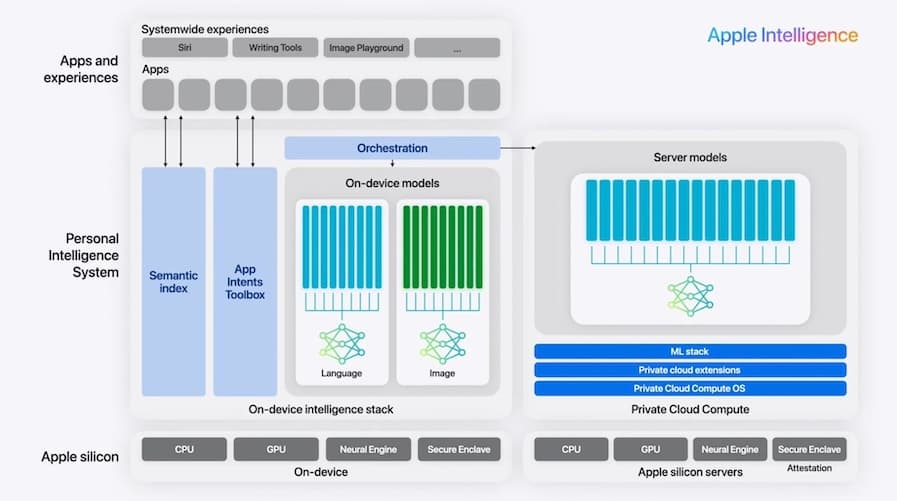
- Enable Hybrid AI: Create a seamless "hybrid compute" architecture where AI tasks are intelligently split between the powerful neural engines in iPhones/Macs and the more powerful "Balta" chips in Apple's data centers, all running a unified software framework.
What to Watch
This report is a signal of intent, not a product announcement. Key questions remain:
- Timeline: When will "Balta" or its successors be deployed in Apple's data centers?
- Architecture: Is it focused on AI inference (running models), training (building models), or both?
- Software: How will developers and Apple's own services (like a potential next-generation Siri) access this new silicon?
The move would place Apple in direct competition with other hyperscalers designing their own AI silicon, including Google's TPU, Amazon's Trainium/Inferentia, and Microsoft's reported Maia chip. It also underscores the industry-wide shift towards custom silicon to meet the unique and massive computational demands of modern AI.
gentic.news Analysis
This development, if accurate, is a pivotal moment in Apple's AI strategy. For years, Apple's AI narrative has been almost exclusively about on-device processing, leveraging the privacy and latency benefits of its custom Neural Engines. The reported push into data center AI silicon ("Balta") represents a necessary, if belated, acknowledgment that the most capable AI models will require cloud-scale compute for the foreseeable future. Apple cannot build a competitive ChatGPT or Gemini rival solely on an iPhone's Neural Engine.
This aligns with the broader industry trend we've covered extensively, where vertical integration from cloud to chip is becoming a competitive moat. We saw this with Google's TPU v5p launch and Amazon's ongoing Trainium/Inferentia roadmap. Apple entering this fray validates the model but also raises the stakes. Their expertise in silicon design for stringent power envelopes (crucial for mobile) could translate into uniquely efficient data center chips, potentially changing the cost structure of large-scale AI inference.
However, the challenge is immense. Designing a cloud AI chip is a different discipline from designing a mobile SoC. The software ecosystem—compilers, frameworks, model deployment tools—is just as critical as the hardware. Apple will need to build or deeply adapt this stack for developers, a area where NVIDIA's CUDA ecosystem remains dominant. The success of "Balta" will depend as much on the software and services it enables as on its transistor count.
Frequently Asked Questions
What is an AI ASIC?
An AI ASIC (Application-Specific Integrated Circuit) is a chip designed from the ground up to accelerate specific artificial intelligence workloads, such as the matrix multiplications fundamental to neural networks. They are more efficient for these tasks than general-purpose CPUs or even GPUs, offering better performance per watt. Examples include Google's TPU, Amazon's Trainium, and now, reportedly, Apple's "Balta."
Why would Apple build its own data center AI chip?
Apple is likely pursuing its own AI ASIC for three core reasons: cost control (reducing dependency on expensive third-party chips like NVIDIA's), performance optimization (tailoring hardware to its specific AI software and models), and strategic independence. Owning the full stack from silicon to service allows for deeper integration, potential efficiency gains, and a unique selling proposition for future AI features.
How does this relate to the AI features in iOS and macOS?
This development suggests a "hybrid compute" future for Apple's AI. Simple, privacy-sensitive tasks would continue to run on the Neural Engine in your iPhone or Mac (like photo segmentation or live transcription). More complex requests requiring massive models (e.g., advanced content generation, deep research) would be routed securely to Apple's data centers, powered by chips like "Balta." This provides a balance of privacy, responsiveness, and access to cutting-edge AI capabilities.
When will we see products using Apple's cloud AI chip?
The report does not specify a timeline. Developing, testing, and deploying a new data center chip architecture is a multi-year endeavor. Given the report mentions "materially ramping" development, it is unlikely we will see public-facing services powered by "Balta" before late 2026 or 2027. Apple's first major cloud AI services may initially run on purchased hardware before transitioning to its own silicon.