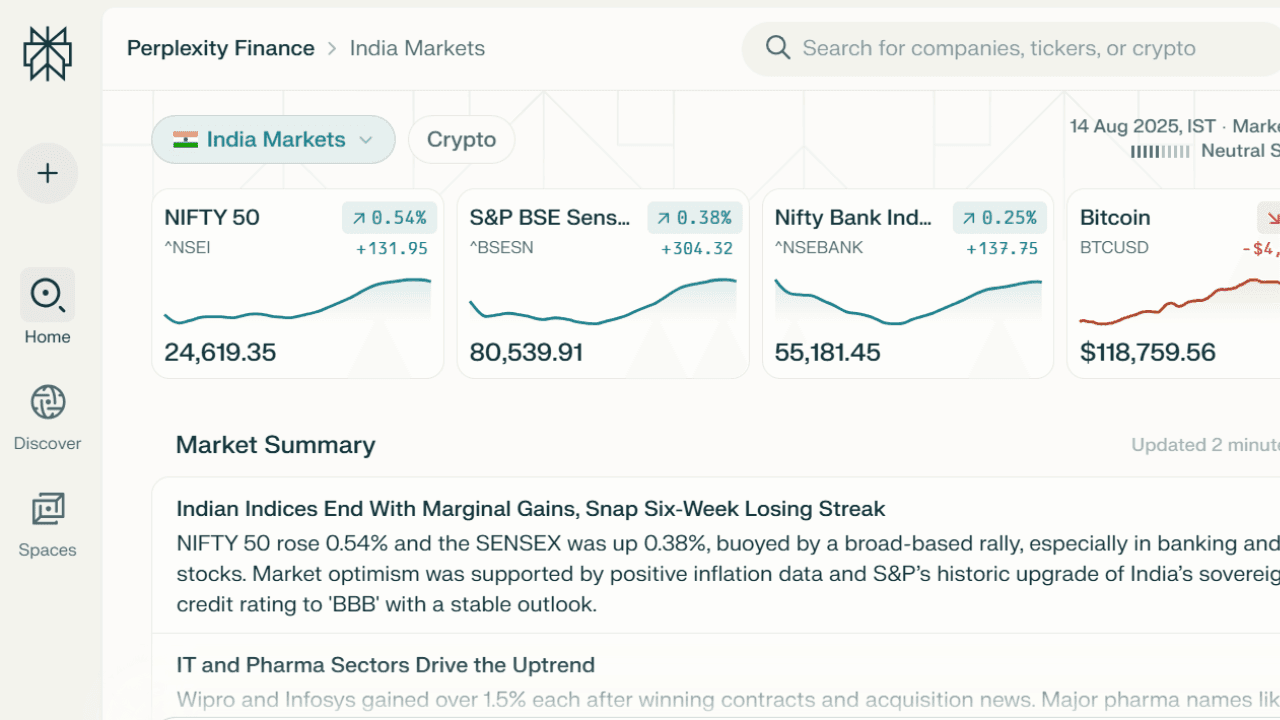
Perplexity AI has significantly upgraded its financial capabilities, moving from a general finance question-and-answer feature to a live, personalized money analyzer. The key enabler is a new integration with Plaid, the financial data aggregation platform that connects to thousands of banks and financial institutions.
What Happened
Based on the announcement, Perplexity has activated a connection to Plaid's API. This integration allows Perplexity's AI to securely access a user's real-time financial transaction data—with explicit user consent—after the user links their bank or credit card accounts through Plaid's authentication flow.
The core upgrade is the shift from a static Q&A tool that could answer general questions about finance (e.g., "What is a Roth IRA?") to a dynamic personal analyzer that can answer questions specific to a user's own financial life (e.g., "How much did I spend on dining out last month?" or "What's my current cash flow across all accounts?").
Context & Competitive Landscape
This move places Perplexity in direct competition with a growing cohort of AI-native personal finance applications. Companies like Copilot and Rocket Money have built their value proposition on connecting to user accounts to provide insights and budgeting tools, often powered by machine learning categorization.
However, Perplexity's approach is distinct: it layers this data access on top of its existing conversational, search-oriented interface. Instead of navigating a dedicated budgeting app dashboard, a user can simply ask Perplexity a natural language question about their finances and receive an answer synthesized from their live data.
The technical foundation relies on Plaid's infrastructure, which handles the secure credential exchange, data aggregation, and normalization from disparate financial institutions, presenting a unified data schema to Perplexity's backend.
Potential Capabilities & User Flow
While specific features weren't detailed in the brief announcement, the "live personal money analyzer" description suggests functionalities could include:
- Transactional Queries: "Show me all Amazon purchases over $50 from last week."
- Spending Analysis: "Break down my spending by category for March."
- Cash Flow & Net Worth: "What is my current checking account balance and total credit card debt?"
- Trend Identification: "Is my grocery spending trending up or down compared to last quarter?"
- Goal-Based Q&A: "Am I on track to save $5,000 by the end of the year based on my current savings rate?"
The user experience likely involves a new "Finance" mode or profile within the Perplexity interface, prompting a user to "Connect your accounts" via Plaid to enable the personalized features.
Security & Privacy Implications
Any service that accesses raw financial data introduces significant security and privacy considerations. Perplexity will need to clearly communicate its data handling policies:
- Whether transaction data is used to further train its core models.
- How long data is retained.
- The security certifications (like SOC 2) it holds.
- The specifics of its partnership with Plaid, which acts as the data conduit and never shares user banking credentials with the connected app.
Adoption will hinge on user trust in Perplexity's and Plaid's combined security posture.
gentic.news Analysis
This is a logical and aggressive expansion for Perplexity. The company has consistently positioned itself as an "answer engine" rather than just a chatbot, aiming to provide authoritative, source-backed information. Access to a user's personal financial data is the ultimate authoritative source for personal finance questions, making this a coherent product evolution.
Strategically, this moves Perplexity beyond competing solely with ChatGPT or Google Gemini on general knowledge and into a high-value vertical: personal finance. This sector has high user engagement and multiple monetization pathways, including premium subscriptions for advanced analytics—a model Perplexity already employs with its Pro plan.
The integration also highlights the growing trend of AI interfaces sitting atop specialized data platforms. Plaid provides the regulated, messy infrastructure of financial connectivity; Perplexity provides the natural language interface. This division of labor is becoming a common pattern, similar to how AI coding assistants rely on GitHub's codebase or legal AI relies on Westlaw/LEXIS-NEXIS data.
For the competitive landscape, this is a shot across the bow of dedicated personal finance apps. While those apps offer deep, purpose-built interfaces, Perplexity is betting that users will prefer the convenience of asking questions in a familiar, general-purpose AI interface they already use daily. The success of this feature will be a key test of whether a horizontal AI assistant can successfully absorb vertical-specific functionalities that have traditionally required standalone apps.
Frequently Asked Questions
How does Perplexity's money analyzer work?
It works by using Plaid's technology. When you choose to use the feature, you'll be prompted to securely link your bank, credit card, or investment accounts through Plaid's interface. Once connected, Plaid fetches and standardizes your transaction data, which Perplexity's AI can then read and analyze to answer your specific financial questions in natural language.
Is it safe to link my bank account to Perplexity?
The safety relies on the security practices of both Perplexity and Plaid. Plaid is a widely used, reputable financial data platform that uses bank-level encryption and never shares your login credentials with Perplexity. You should review Perplexity's specific privacy policy for the feature to understand how they handle and store your financial data.
How is this different from apps like Mint or Rocket Money?
The core difference is the interface. Traditional personal finance apps provide dashboards, charts, and alerts. Perplexity's analyzer is primarily conversational—you ask questions and get answers. It's integrated into a general AI assistant you might use for other tasks, rather than being a separate, dedicated budgeting application.
Will this feature cost money?
The announcement did not specify pricing. It could be included in the existing Perplexity Pro subscription, offered as a separate premium add-on, or have a freemium tier with limited queries. Perplexity's historical model suggests advanced features like this are likely tied to its paid Pro plan.