Setting up a powerful, open-source AI agent like OpenClaw (also known as Clawdbot) has historically been a technical hurdle, requiring command-line expertise and manual configuration. Atomic Bot has now released a native desktop application designed to eliminate that friction, bringing OpenClaw's capabilities to a broader audience through a simplified, one-click installation process.
What Happened
Atomic Bot has developed and released a fully open-source, native desktop application for macOS and Windows. Its primary function is to drastically simplify the deployment and configuration of the OpenClaw AI agent. The app is distributed as a standard desktop application, allowing users to install it like any other program without needing to manage dependencies or run complex shell commands.
Key Features & Technical Details
The core value proposition is ease of use. After installation, users can choose the desired capabilities for their OpenClaw instance and begin using it immediately as a personal AI assistant.
Deployment Flexibility: The application supports multiple deployment modes, giving users control over where their agent runs:
- On Your Own Device: For privacy and offline use.
- In the Cloud: For accessibility and potentially greater computational power.
- Hybrid Setup: A combination of local and cloud resources, depending on the user's specific workflow needs.
Platform Support & Roadmap: The initial release supports macOS and Windows. Support for Linux is confirmed to be in development and "coming soon." The application's code is publicly available on Atomic Bot's GitHub repository.
Context: The OpenClaw (Clawdbot) Ecosystem
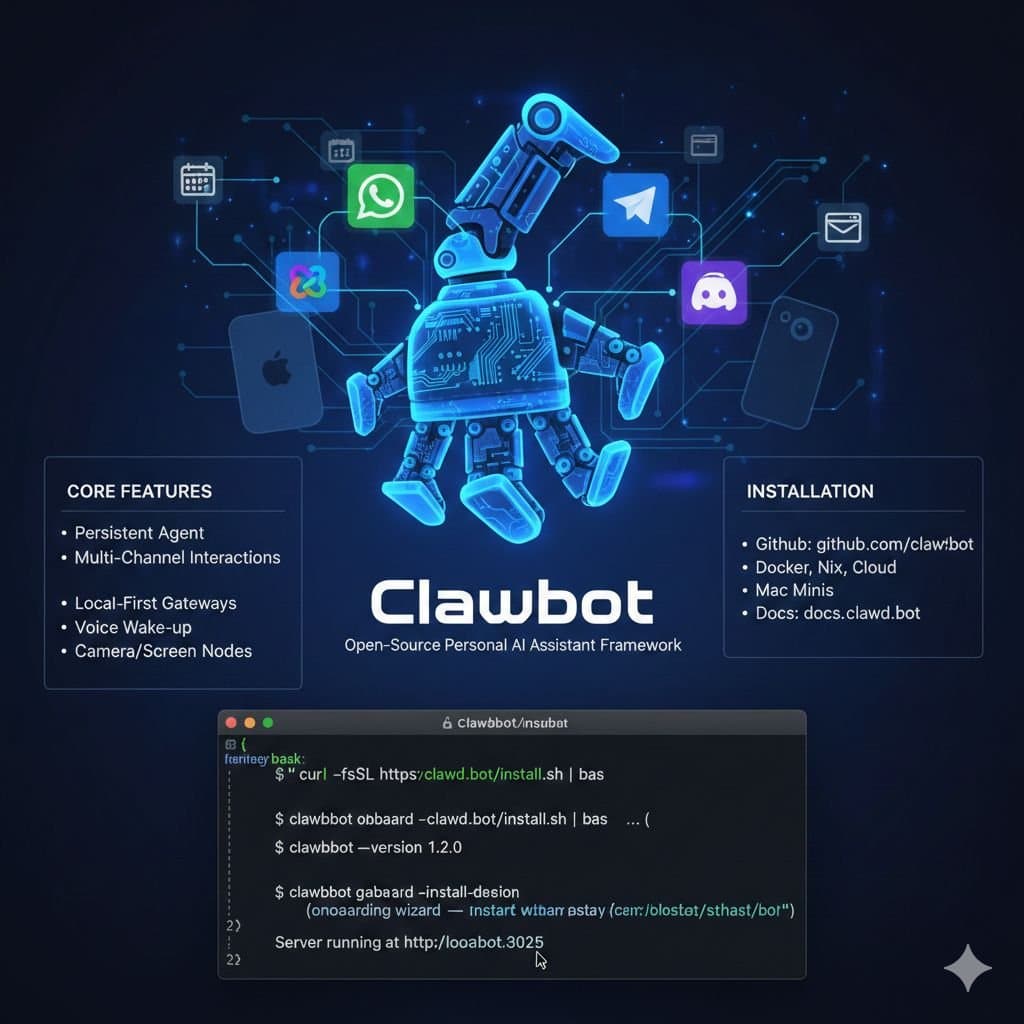
OpenClaw has gained attention as a sophisticated, open-source framework for building autonomous AI agents capable of complex, multi-step tasks. Its power is derived from its ability to chain reasoning, use tools, and interact with various APIs. However, its adoption has been gated by technical complexity, primarily appealing to developers and researchers comfortable with terminal-based workflows. Atomic Bot's application directly addresses this barrier to entry.
What This Means in Practice
This development represents a clear move towards the productization of open-source AI agent frameworks. By abstracting away the setup complexity, Atomic Bot is enabling non-technical users, researchers focusing on application rather than infrastructure, and businesses to experiment with and deploy powerful agentic workflows without a deep DevOps background. It lowers the activation energy required to go from "hearing about AI agents" to "running one on my computer."
gentic.news Analysis
This release is a tactical move within the rapidly maturing AI agent landscape. While foundational models from Anthropic (Claude), OpenAI (o1, GPT-4), and Google (Gemini) provide the reasoning engines, the real-world utility depends on frameworks like OpenClaw that enable tool use and task automation. Atomic Bot's contribution is not a new core technology, but a crucial piece of usability infrastructure that could accelerate real-world adoption.
This trend mirrors the evolution of other developer tools. Just as Docker simplified containerization, Atomic Bot's app aims to simplify agent deployment. The focus on multi-platform native apps (versus a web-only interface) is significant, as it caters to users who prioritize desktop integration, offline functionality, and data privacy by keeping workflows local.
The success of this approach will hinge on a few factors: the stability and performance of the wrapped OpenClaw instance, the ease of configuring complex agentic workflows through a GUI, and how quickly the team can iterate based on user feedback. If successful, it could establish a template for other open-source AI projects seeking to broaden their user base beyond the core developer community.
Frequently Asked Questions
What is OpenClaw (Clawdbot)?
OpenClaw, also referred to as Clawdbot, is an open-source framework for building and running advanced AI agents. These agents can understand complex goals, break them down into steps, use tools (like web browsers, calculators, or APIs), and execute tasks autonomously.
How is Atomic Bot's app different from running OpenClaw manually?
Running OpenClaw manually typically involves cloning a GitHub repository, installing Python dependencies, setting up environment variables, and potentially configuring a database. Atomic Bot's app packages all of this into a standard desktop installer, handling the technical setup behind a simple graphical interface.
Is the Atomic Bot application itself free and open-source?
Yes. According to the announcement, Atomic Bot is a "fully open source app." The code is available on their GitHub, meaning users can audit it, modify it, and contribute to its development.
When will the Linux version be available?
The announcement states that Linux support is "coming soon." No specific release date was provided. Users interested in the Linux version should monitor Atomic Bot's GitHub repository for updates.