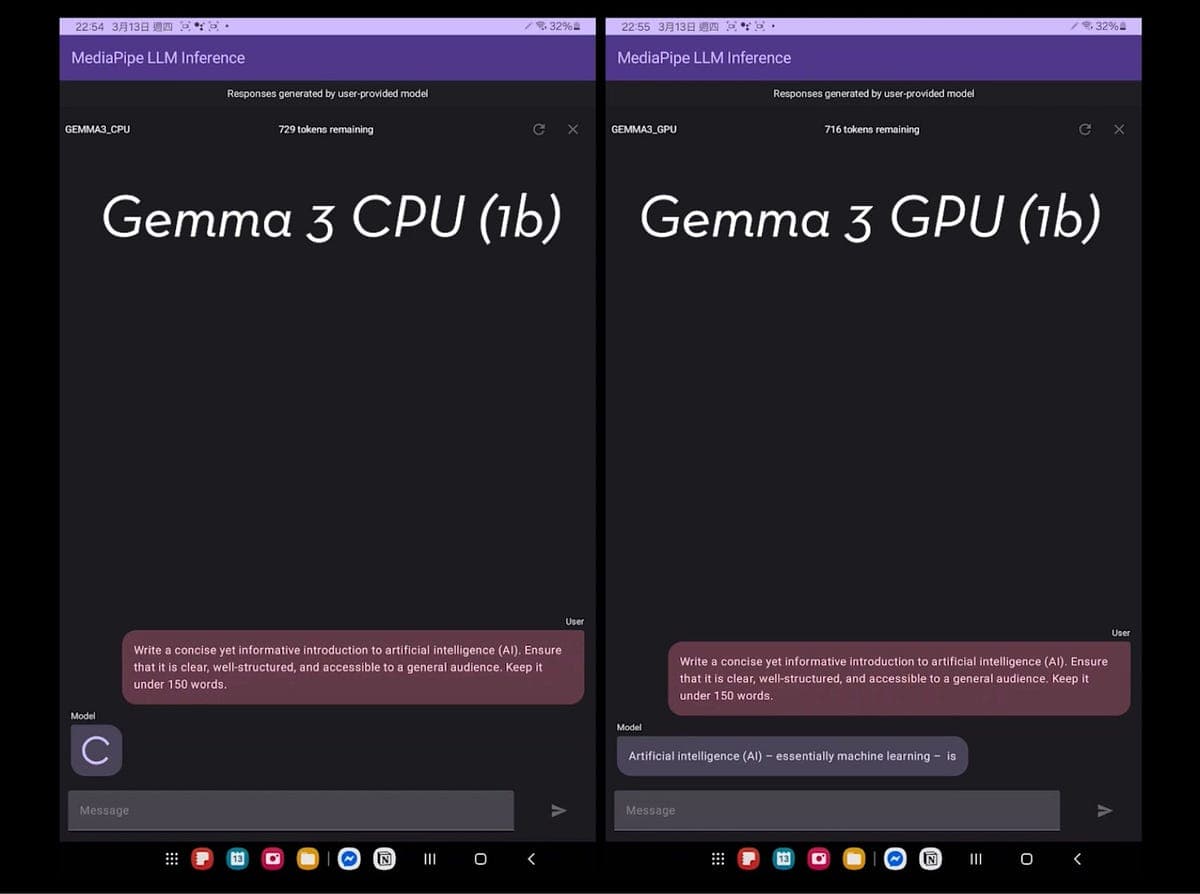
A developer demonstration shows the OpenClaw client running Google's Gemma 4 model locally on a base-configuration MacBook Air with 16GB of RAM, achieving an inference speed of 25 tokens per second. The key enabling technology is Atomic Chat's newly mentioned TurboQuant algorithm, which applies aggressive compression specifically to the model's Key-Value (KV) cache.
What Happened
Developer @kimmonismus posted a demonstration showing the OpenClaw application successfully running the Gemma 4 language model. The hardware was a standard MacBook Air equipped with 16GB of unified memory (Apple Silicon). The reported performance was 25 tokens per second, a usable speed for interactive local chat. The post credits Atomic Chat's TurboQuant for making this possible by compressing the KV cache so that models previously requiring 32GB or more of RAM can now function on this entry-level hardware.
The core claim is that this compression is "aggressive" and targets the KV cache—a memory structure in transformer models that stores computed keys and values for previous tokens in a sequence to enable efficient generation of subsequent tokens. This cache is a primary memory bottleneck for running large models locally.
Technical Context: The KV Cache Bottleneck
Running large language models (LLMs) locally involves two main computational phases: the initial prompt processing (prefill) and the sequential generation of tokens (decoding). During decoding, the model stores the KV pairs for all previously generated tokens in the current session. For a model with a large context window (e.g., 128K tokens), this cache can consume gigabytes of memory, often exceeding the capacity of consumer hardware and forcing the use of slower, offloaded memory or cloud APIs.
Quantization—reducing the numerical precision of model weights from 16-bit to 4-bit or 8-bit—has been the primary method for shrinking model size. However, the KV cache has remained a stubborn, separate memory hog. Techniques like KV cache quantization and paged attention (as seen in vLLM) have emerged to tackle this, but achieving high compression ratios without catastrophic performance degradation is challenging.
Atomic Chat's TurboQuant appears to be a specialized algorithm pushing the boundaries of this specific compression problem.
What This Means in Practice
- Hardware Democratization: High-performance local AI is no longer gated by owning specialty hardware with 64GB+ of RAM. A standard 16GB MacBook Air becomes a viable platform.
- Cost Elimination: As stated, this approach requires "No cloud, no API costs." Users avoid per-token pricing and maintain full data privacy.
- Client Flexibility: The demo uses the OpenClaw client, suggesting the TurboQuant technique may be integrated into or compatible with existing local inference stacks, rather than being locked to a single application.
Limitations & Caveats
The source is a single social media post from a developer, not an official whitepaper or benchmark release from Atomic Chat. Key details are missing:
- The exact compression ratio and precision (e.g., 4-bit, 8-bit) of TurboQuant.
- The performance trade-off: What is the impact on model output quality or accuracy? Aggressive compression can introduce artifacts.
- Broader compatibility: Is it specific to Gemma's architecture, or does it work with Llama, Mistral, and other transformer models?
- Official availability and integration path for other developers.
The 25 tokens/second speed is context-dependent (sequence length, generation parameters) but represents a solid, interactive rate for a model of Gemma 4's presumed scale on an efficiency-focused laptop.
gentic.news Analysis
This development is a direct shot in the ongoing local vs. cloud AI war. For the past two years, the trend has been clear: model capabilities have grown faster than consumer hardware, pushing most advanced applications to the cloud. Companies like Anthropic (Claude) and OpenAI (GPT-4o) have built massive businesses on this cloud-centric model. However, a persistent counter-trend, led by efforts like Llama.cpp, Ollama, and MLC LLM, has focused on extreme optimization for local deployment.
Atomic Chat's TurboQuant enters a competitive space for KV cache optimization. Microsoft's DeepSpeed-FastGen and the open-source vLLM framework have also made significant strides in efficient KV cache management, primarily for server deployments. TurboQuant's distinct angle is its aggressive targeting of the memory-constrained edge device, specifically Apple Silicon Macs, which have become the default development platform for many but are often limited to 16GB or 24GB configurations.
If the claims hold under scrutiny, this could significantly alter the hardware calculus for startups and developers building AI-native applications. Building on a foundation of local inference plus optional cloud scaling becomes more feasible, reducing initial infrastructure costs and complexity. It also aligns with increasing regulatory and consumer demand for data privacy. The next step is for Atomic Chat to publish technical details or benchmarks, allowing the community to validate performance and integrate the technique into the broader local AI ecosystem.
Frequently Asked Questions
What is TurboQuant?
TurboQuant is an algorithm developed by Atomic Chat that applies aggressive compression specifically to the Key-Value (KV) cache of large language models. The KV cache is a major memory bottleneck when running models locally. By compressing it, TurboQuant allows larger models to run on hardware with less RAM.
How fast is 25 tokens per second?
Twenty-five tokens per second is a highly usable speed for interactive chat. For comparison, a fast typist might manage 5-6 words per second. Since a token is roughly ¾ of a word, 25 tok/s translates to the model generating text noticeably faster than a human can read it, enabling smooth, real-time conversation.
Can I use TurboQuant with any model?
Based on the single demo, it works with the Gemma 4 model via the OpenClaw client. Its compatibility with other model architectures (like Llama 3, Mistral, or Qwen) has not been demonstrated. The technique is likely dependent on the transformer architecture but may require specific integration for each model family.
Is there a loss in model quality with this compression?
The source does not specify. Aggressive quantization of the KV cache can potentially introduce errors or "drift" in the model's attention mechanism over long conversations, which may degrade output coherence or factual accuracy. The true test will be benchmark results comparing the TurboQuant-compressed model's performance against the full-precision version on standard evaluation tasks.