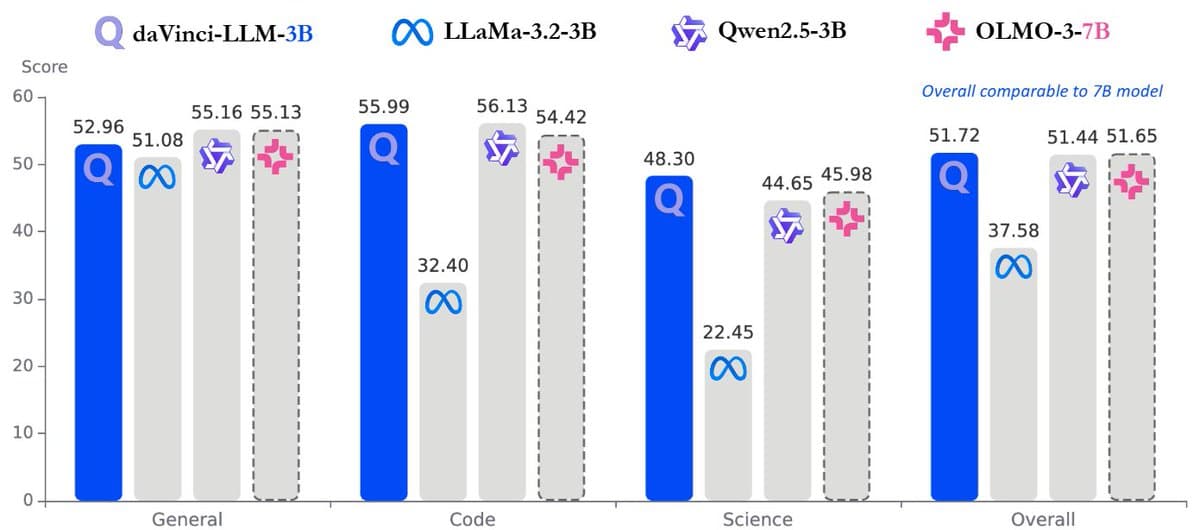
A new, fully open-source language model called daVinci-LLM is challenging the conventional wisdom that bigger parameter counts are the primary path to better performance. The team has released a 3 billion parameter model that they claim matches the performance of typical 7 billion parameter models. More significantly, they have open-sourced the entire stack: the model weights, the complete data processing pipelines, the training code, and the results of over 200 ablation studies.
What's New: A Complete Open-Source Release
This isn't just a model drop. The daVinci-LLM release is a comprehensive package aimed at advancing reproducible, efficient language model training.
- The Model: A 3B parameter decoder-only transformer model.
- Training Scale: Trained from scratch on 8 trillion tokens of text data.
- Core Claim: The model's performance on standard benchmarks is comparable to existing open-source models with over twice the parameters (7B class).
- Full Stack Openness: The release includes:
- Model weights on Hugging Face.
- Complete data preprocessing and curation pipelines ("complete data pipelines").
- The full training code and infrastructure.
- Documentation of 200+ ablation studies used to arrive at the final architecture and training recipe.
The Technical Core: Data Darwinism and L0-L9 Processing
The key innovation highlighted by the team is the "Data Darwinism" framework. This is a systematic, multi-stage data processing methodology. The framework applies a hierarchy of processing steps, labeled L0 through L9, to raw text data. Each level applies increasingly sophisticated filtering, deduplication, quality scoring, and content transformation.
The central thesis is that this deep, systematic processing of training data—achieving high "processing depth"—can be a substitute for simply scaling up model parameters. The 200+ ablations released likely detail experiments comparing different data mixtures, filtering strategies, and training schedules that led to this efficiency breakthrough.
How It Compares: Efficiency vs. Scale
While specific benchmark numbers are not provided in the initial announcement, the claim positions daVinci-LLM 3B against popular open-source 7B models like Meta's Llama 3.1 8B, Mistral's 7B v0.3, and Qwen2.5 7B. If validated, this represents a greater than 2x improvement in parameter efficiency.
daVinci-LLM 3 Billion 8 Trillion Matches performance of 7B-class models Meta Llama 3.1 8 Billion 15 Trillion General-purpose 8B baseline Mistral 7B v0.3 7.3 Billion Not Public Strong 7B performer Qwen2.5 7B 7.7 Billion 6-14 Trillion (est.) Multilingual capabilitiesWhy This Matters for Practitioners
For AI engineers and researchers, this release is significant for two reasons:
- A Blueprint for Efficient Training: The complete open-source nature provides a rare, production-grade template for how to build a high-quality LLM from the ground up, emphasizing data curation over brute-force scaling. This lowers the barrier to entry for organizations without vast compute resources.
- Challenging Scaling Dogma: It provides concrete evidence that the relentless focus on parameter count may be overlooking significant gains available through superior data selection and processing. The "Data Darwinism" framework offers a structured approach to explore this frontier.
Limitations and What to Watch
The initial announcement lacks published benchmark scores on standard evaluations like MMLU, GSM8K, or HumanEval. The community will need to independently verify the performance claims against established 7B models. Furthermore, the computational cost of the L0-L9 data processing pipeline is not detailed; sophisticated data curation can itself be expensive.
The real test will be in widespread community adoption and benchmarking. If the claims hold, daVinci-LLM could become a preferred base model for fine-tuning and deployment where memory and latency constraints are critical.
gentic.news Analysis
This release taps directly into one of the most active currents in modern LLM research: the search for efficiency beyond scaling laws. For years, the dominant narrative, reinforced by landmark papers from OpenAI and DeepMind, has been that performance predictably scales with compute, dataset size, and parameter count. daVinci-LLM's "Data Darwinism" framework represents a concerted effort to bend that curve, suggesting that algorithmic improvements in data selection can deliver "free" performance gains equivalent to a major parameter increase.
This aligns with a broader trend we've been tracking: the rise of data-centric AI as a counterweight to model-centric scaling. Just last month, we covered Yoshi's DataOps platform raising $40M to automate LLM data pipelines, highlighting the growing market and research focus on the data supply chain. The daVinci-LLM team's decision to release 200+ ablations is particularly valuable; it transforms the release from a black-box model into a research artifact that allows others to trace the engineering decisions that led to the result. This level of transparency is still uncommon for performance-competitive models and could accelerate community progress in efficient training.
If the 3B-vs-7B performance claim is validated, it has immediate practical implications. It would enable higher-quality inference on edge devices, reduce serving costs for API providers, and lower the hardware barrier for organizations wanting to host their own capable models. The next step is for independent evaluators to run the standard benchmark suite and for the community to test the released pipelines to see if the results are reproducible.
Frequently Asked Questions
What is the "Data Darwinism" framework?
Data Darwinism is the systematic, multi-stage data processing methodology developed by the daVinci-LLM team. It involves applying ten levels (L0-L9) of progressive filtering, deduplication, and quality enhancement to raw text data. The core idea is that rigorously "evolving" the training dataset through this deep processing pipeline can improve model performance as effectively as adding more parameters.
Where can I download the daVinci-LLM model and code?
The full release, including model weights, data pipelines, training code, and ablation studies, is available on the Hugging Face Hub. You can search for "daVinci-LLM" on the Hugging Face website to find the official repository and begin experimenting with the model and framework.
How does a 3B model match a 7B model's performance?
According to the daVinci-LLM team, the performance parity is achieved not through a novel model architecture, but through a superior training data pipeline. By training on a massive, carefully curated 8-trillion-token dataset processed through their Data Darwinism framework, the 3B parameter model learns more efficiently, effectively closing the gap that would typically exist between 3B and 7B parameter models trained on less refined data.
What are the practical benefits of a smaller, equally performant model?
A smaller model with competitive performance has significant advantages: it requires less GPU memory (VRAM) for inference, allowing it to run on more affordable hardware or alongside other applications. It also has faster inference latency, lower hosting costs, and a reduced environmental footprint during both training and deployment. This makes high-quality AI more accessible for on-device applications, cost-sensitive startups, and large-scale API services.