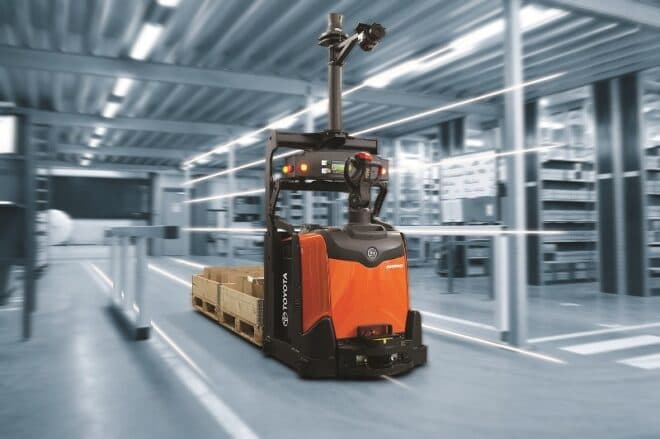
A video posted on social media shows a significant step in warehouse automation: a fully driverless forklift operating inside a Costco warehouse in South Jersey. The machine navigates directly into a shipping trailer, clears pallets one by one, and backs out—all without a human operator in sight.
What Happened
The footage depicts a standard warehouse scene with a crucial difference: the absence of a human driver. The autonomous forklift performs a complete pallet clearance cycle. It enters the confined space of a trailer, manipulates pallets, and exits. The process appears smooth and continuous, suggesting the system is designed for repeated, real-world operation rather than a controlled demo.
Context
Automating forklift operations is a major target for robotics and AI companies. Unlike autonomous guided vehicles (AGVs) that follow fixed paths, this type of system requires advanced perception, navigation, and manipulation to handle dynamic, unstructured environments like loading docks and trailer interiors. Successfully deploying such technology in a high-volume retail environment like Costco represents a notable validation of robustness.
The Technical Challenge
Developing an autonomous forklift for trailer unloading is a complex problem. The system must:
- Perceive in low-light, high-contrast environments: The interior of a trailer is dark compared to a well-lit warehouse.
- Navigate precisely in tight spaces: The clearance between the forklift and trailer walls is often minimal.
- Handle variable loads: Pallets can be stacked inconsistently or shift during transport.
- Operate safely around humans and other equipment: This is non-negotiable in a busy warehouse.
The video suggests the deployed system has overcome these hurdles for this specific task.
Market and Competitive Landscape
The push for warehouse automation is accelerating due to labor shortages, efficiency demands, and the need for 24/7 operations. Companies like Boston Dynamics (with its Stretch robot), Vecna Robotics, Seegrid, and Toyota are actively developing and deploying autonomous material handling solutions. A deployment at a major retailer like Costco is a strong signal of commercial readiness.
Frequently Asked Questions
Who makes the autonomous forklift shown in the Costco video?
The video source does not identify the manufacturer. Several robotics companies, including Boston Dynamics (Stretch), Vecna Robotics, and Seegrid, produce autonomous mobile robots for pallet handling. The specific system would need to be confirmed by Costco or the operator.
Is this technology safe to use around human workers?
A core requirement for any autonomous system deployed in shared spaces is safety certification. These systems typically use a suite of sensors (LiDAR, cameras, radar) for 360-degree perception and are programmed with strict safety protocols, including automatic slowdowns and stops when humans are detected in predefined zones. Their deployment suggests they have met the site's safety standards.
What does this mean for warehouse jobs?
In the near term, autonomous forklifts are likely to augment human labor, handling repetitive, heavy, or potentially dangerous tasks like trailer loading/unloading. This could shift human roles toward supervision, exception handling, maintenance, and more complex value-added tasks, rather than eliminating them outright. The long-term impact on job composition is an ongoing topic of industry analysis.
How mature is this autonomous forklift technology?
The video indicates a high level of operational maturity, as it is performing a complex task in a live commercial environment, not a lab. However, maturity varies by use case. A system perfected for pallet retrieval from a known trailer position in a specific warehouse may not yet generalize to all warehouse layouts or all types of cargo without significant reconfiguration or training.
gentic.news Analysis
This sighting is a concrete data point in the steady, incremental infiltration of autonomy into industrial settings. It's not about a flashy humanoid robot; it's about a single-purpose machine reliably executing a costly and physically demanding workflow. The choice of location—a Costco warehouse—is significant. Big-box retailers operate on razor-thin margins where logistics efficiency is paramount. A successful pilot here is a stronger market signal than one in a tech company's R&D center.
This development aligns with the broader trend we've covered of AI moving from perception to action. For years, computer vision systems could identify pallets. Now, integrated systems can physically manipulate them in the real world. The key differentiator is the integration of robust navigation stacks (likely combining SLAM and deep learning-based path planning) with precise control systems for the forklift hydraulics and mast.
Looking at the competitive landscape, this pushes against the narrative that only general-purpose humanoid robots will automate physical work. Specialized systems like this autonomous forklift can achieve commercial viability and ROI faster by solving a specific, high-value problem extremely well. The race is not just about who has the most advanced AI, but who can best integrate that AI into durable, safe, and maintainable hardware that meets the brutal cost/benefit analysis of logistics managers. This Costco video suggests that race is heating up on the warehouse floor.