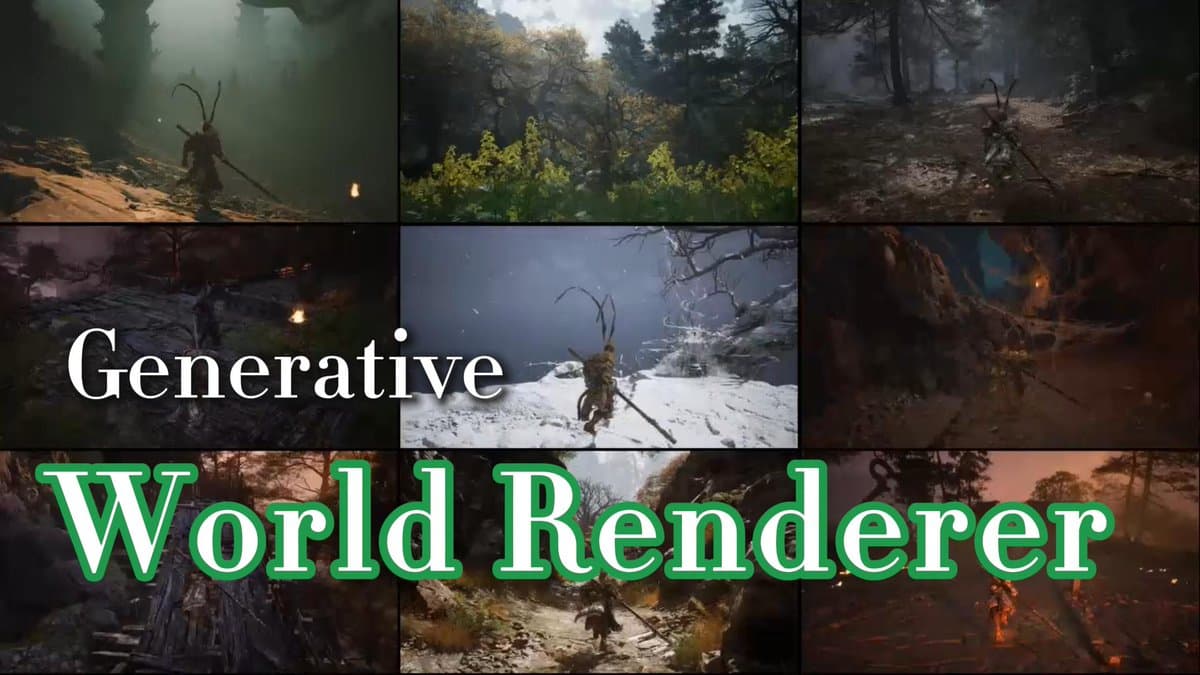
A new research initiative has released a large-scale dataset and framework designed to bridge the gap between high-fidelity game visuals and generative AI models. Dubbed the "Generative World Renderer," the project extracts over 4 million synchronized RGB images and corresponding graphics buffer (G-buffer) frames from two modern AAA titles: CD Projekt Red's Cyberpunk 2077 and Game Science's Black Myth: Wukong.
The core goal is to enable bidirectional rendering—training AI systems not just to generate images, but to understand and decompose complex, photorealistic game scenes into their underlying components. This "inverse graphics" capability could allow for controllable editing of game environments at the material, lighting, and geometry level.
What the Dataset Provides
The dataset is built on a key technical pairing: for every RGB frame a player sees, the framework captures the corresponding G-buffer. A G-buffer is a collection of intermediate rendering data produced by a game engine during a single frame, typically including per-pixel information like:
- World Position: The 3D coordinates of each surface.
- Surface Normals: The direction a surface is facing.
- Albedo/Diffuse Color: The base color of a material without lighting.
- Roughness/Metallic: Physical-based rendering (PBR) material properties.
- Depth: Distance from the camera.
By capturing this synchronized data at scale during gameplay, the dataset creates a massive, naturally varied corpus for training. The 4M+ frames from Cyberpunk 2077 (a dense, neon-drenched cyberpunk city) and Black Myth: Wukong (a lush, mythologically-inspired world) provide diverse visual styles, lighting conditions, materials, and geometries.
The Framework's Purpose: Inverse Material Decomposition & Controllable Editing
The stated applications are inverse material decomposition and controllable game environment editing.
Inverse Material Decomposition: This is the process of taking a 2D RGB image and inferring the full set of underlying G-buffer properties. It's an ill-posed problem—many different material/lighting combinations can produce the same final pixel. A model trained on this massive, perfectly aligned dataset learns the complex mapping from final render to its constituent parts. For example, it could look at a screenshot of a wet, neon-lit street in Night City and estimate the albedo of the asphalt, the intensity and color of the neon signs, and the roughness of the puddles.
Controllable Game Environment Editing: Once a scene is decomposed, you can edit it. A user or developer could, in theory, select an object in a game screenshot and instruct an AI: "make this metal surface more corroded" or "change the time of day to sunset." The AI, understanding the scene's material and lighting layers, could generate a plausible edited G-buffer, which could then be re-rendered or used to modify game assets.
Technical Implications for AI Research
This dataset directly tackles a major bottleneck in neural rendering and inverse graphics research: the lack of large-scale, high-quality, synchronized RGB and ground-truth scene data. Previous datasets were often smaller, synthetic, or lacked the visual complexity of a modern AAA game.
Training on this data could lead to models that are significantly more robust at understanding real-time rendered visuals, which dominate digital media (games, VR, film VFX). It moves beyond datasets of static photos or simple synthetic objects to the dynamic, interactive, and artistically crafted worlds of games.
Potential Applications and Limitations
Potential Applications:
- Game Development & Modding: Rapid asset re-texturing, lighting scenario generation, and environment prototyping.
- Content Creation: Generating consistent multi-view content for trailers or marketing from single screenshots.
- AI Research: A new benchmark for neural rendering, material estimation, and scene understanding models.
- Film & Animation: Applying game-derived inverse rendering techniques to pre-rendered CGI.
Key Limitations & Considerations:
- Game-Specific Artifacts: Models may learn the specific rendering quirks of the REDengine (Cyberpunk 2077) and Unreal Engine (Black Myth: Wukong).
- Limited Generalization: Performance on non-game imagery (e.g., real-world photos) is untested and may be poor.
- Legal & Ethical Use: The dataset comprises copyrighted game assets. Its release for research likely hinges on specific non-commercial, academic-use licenses. Widespread commercial application would require significant legal navigation.
- Control Granularity: The paper/tweet does not specify the ease or precision of the proposed "controllable editing." It may remain a coarse tool rather than a pixel-perfect editor.
gentic.news Analysis
This release is a strategic move in the ongoing convergence of game development pipelines and generative AI research. It follows a clear trend of using synthetic data from high-fidelity simulators—like NVIDIA's Omniverse or Unity's Perception tools—to train perception and generation models. However, using actual shipped AAA games as the data source is a notable escalation in scale and visual quality. It acknowledges that the most complex and artistically valid synthetic environments already exist in commercial games, not research labs.
This work aligns thematically with other inverse graphics efforts we've covered, such as research on extracting 3D Gaussian Splatting representations from 2D video or projects aiming to "de-render" scenes for editing. Where those often struggle with real-world ambiguity, this dataset provides a controlled but immensely rich sandbox with perfect ground truth. The choice of Black Myth: Wukong is particularly insightful, as its stunning, UE5-powered visuals have made it a benchmark for real-time graphics fidelity, offering a different challenge from Cyberpunk 2077's complex, indirect lighting.
The major hurdle, as with many ambitious AI datasets, will be accessibility and licensing. If the dataset is released publicly under a standard research license (e.g., CC-BY-NC), it could become a foundational benchmark. If it remains restricted or behind a complex access process, its impact will be limited. Furthermore, this approach inherently ties AI progress to the IP of specific game studios, creating a potential friction point between open research and proprietary content that doesn't exist with purely synthetic or photographic datasets.
For practitioners, this is a dataset to watch. If accessible, it provides a unique training ground for models targeting the multi-billion dollar game and interactive media industry. The real test will be whether models trained on "Cyberpunk frames" can decompose and edit scenes from a game they've never seen, like The Elder Scrolls VI or an indie title made in Godot. That generalization challenge is the next frontier.
Frequently Asked Questions
What is a G-buffer?
A G-buffer (Geometry Buffer) is a set of intermediate image-like outputs from a game engine's rendering pipeline. Instead of storing final colored pixels (RGB), each "channel" of a G-buffer stores specific 3D scene information for every pixel, such as its depth, surface normal vector, base material color (albedo), and shininess (roughness). It's the decomposed blueprint used to compute the final lit image.
How is this different from other AI image datasets?
Most large-scale image datasets (like ImageNet or LAION) contain only the final RGB photographs or renders. This dataset provides the synchronized ground-truth breakdown for each RGB frame—the exact material, lighting, and geometry data that produced it. This paired data is rare at this scale and quality, making it uniquely valuable for training AI to understand the "why" behind a pixel's appearance.
Can I use this to mod or change Cyberpunk 2077 directly?
Not directly. The dataset is a collection of screenshots and data extracted from the game. It is for training AI models. To actually modify the game, you would need to use traditional modding tools that interact with the game's own files and engines. However, an AI model trained on this data could, in theory, generate new textures or lighting setups that a modder could then manually implement.
Is this dataset publicly available?
Based on the initial announcement via HuggingPapers (a channel for sharing research papers), the dataset and framework are likely described in an accompanying academic paper. The availability of the dataset itself—whether hosted on Hugging Face, an institutional server, or provided upon request—is not specified in the tweet. Researchers should look for the official paper release for download links and licensing details.