Glass, the subscription-based AI-powered code editor, has ended its platform exclusivity with a full release for Windows. The editor, previously available only on macOS, positions itself as an all-in-one development environment that provides integrated, unlimited access to multiple frontier large language models (LLMs) for a single monthly fee, eliminating the variable costs and billing complexity of direct API usage.
What's New: Windows Support and Model Access
The core announcement is straightforward: Glass is now a cross-platform application. Windows developers can download and use the editor with the same feature set as the Mac version. The primary value proposition remains its bundled AI access.
According to the announcement, the current version of Glass provides integrated access to:
- Anthropic's Claude Opus 4.6
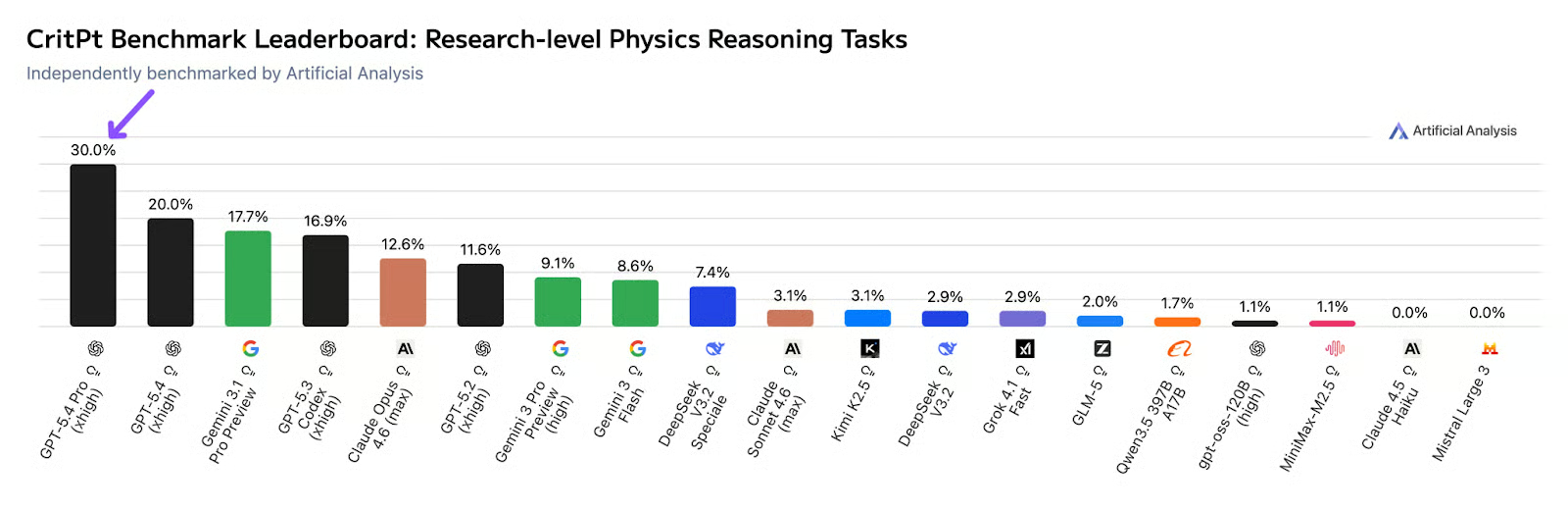
- OpenAI's GPT-5.4
- Google's Gemini 3.1 Pro
Critically, usage of these models within the Glass editor does not incur separate pay-per-token API fees from Anthropic, OpenAI, or Google. The AI compute cost is covered by the user's Glass subscription, which the company markets as enabling "vibe-coding" without "surprise bills."
Technical Details and Positioning
Glass is not just a chat interface wrapped in a text editor. It is designed as a full-fledged coding environment with AI deeply integrated into the workflow. This likely includes features like in-line code generation and explanation, refactoring assistance, debugging, and natural language terminal commands—patterns established by earlier AI coding assistants like GitHub Copilot and Cursor, but with direct access to multiple, competing frontier models.
By bundling model access, Glass abstracts away the choice of provider and the cost management overhead for the individual developer or small team. Users interact with the AI for coding tasks without needing to manage API keys, monitor token consumption across different platforms, or worry about one model being more expensive than another for a given task.
The business model is a classic SaaS play: predictable monthly/annual revenue for Glass, and predictable monthly cost for the developer. For developers who regularly use AI for coding, a flat fee can be more attractive and manageable than variable API costs, especially when using multiple high-cost models like Claude Opus.
How It Compares
Glass enters a crowded market but carves a distinct niche:
Glass Bundled: Claude Opus 4.6, GPT-5.4, Gemini 3.1 Pro Flat subscription fee macOS & Windows Cursor Primarily uses OpenAI models (user supplies API key) Freemium + user pays API costs macOS, Windows, Linux Windsurf Supports multiple models (user supplies API keys) Freemium + user pays API costs Web-based GitHub Copilot Proprietary model (based on OpenAI) Flat subscription fee IDE plugin (multi-platform)Glass's main differentiators are the inclusion of multiple top-tier models and the abstraction of API costs. Unlike Cursor or Windsurf, the user does not need an API subscription with each provider. Unlike GitHub Copilot, it offers choice between model families (Anthropic, OpenAI, Google).
What to Watch: Limitations and Questions
The launch announcement leaves several practical questions unanswered, which potential users will need to evaluate:
- Subscription Tiers & Pricing: The announcement does not specify the monthly cost. The value proposition hinges entirely on this price point relative to expected individual API usage.
- Usage Limits: A "flat fee" almost certainly comes with fair-use limits. The specifics of these limits (e.g., queries per day, tokens per month) are critical and undisclosed.
- Model Version Latency: The editor includes specific model versions (Opus 4.6, GPT-5.4). The commitment and process for updating to new model versions (e.g., GPT-5.5) is unclear.
- Local/On-Device Options: There is no mention of support for local models (e.g., Llama, Qwen), which is a growing segment of the AI coding tool market focused on privacy and offline capability.
- Performance & Integration Depth: The quality of the editor itself—its speed, customizability, and depth of AI integration beyond a chat pane—will determine if it can compete with established editors like VS Code, even with the bundled AI advantage.
gentic.news Analysis
This expansion is a logical and necessary growth step for Glass. Remaining Mac-only in 2026 would have severely capped its total addressable market in the professional development world, where Windows holds significant share, especially in enterprise and game development circles. The move signals that Glass has likely secured sufficient funding or subscription revenue to support the infrastructure costs of a larger user base.
The bundled model strategy is a direct response to the increasing fragmentation and cost complexity of the LLM landscape. As we covered in our March 2026 analysis, "The Great Unbundling: How AI Devs Are Juggling 4+ Model APIs," developers are fatigued by managing multiple accounts, rate limits, and cost structures. Glass productizes a solution to this pain point. However, it also creates a new form of vendor lock-in: your AI coding workflow is now tied to Glass's platform, its chosen model providers, and its pricing.
This launch intensifies competition with Cursor, which has dominated the "AI-native editor" mindshare but relies on the user's own API keys. It also positions Glass as a more direct competitor to GitHub Copilot's all-in-one offering, but with a multi-model, best-of-breed angle. The success of this model will depend heavily on whether Glass can negotiate sustainable rates with the underlying model providers (Anthropic, OpenAI, Google) as its user base scales—a significant business challenge.
Frequently Asked Questions
How much does Glass cost?
The official announcement does not list a price. Interested users must visit the Glass website and likely sign up for a free trial to see the current subscription plans. The cost will be the primary factor in determining its value versus paying for API usage directly.
Can I use my own API keys with Glass?
Based on the announcement emphasizing "ZERO extra API fees," Glass appears to be a closed system where AI access is provided exclusively through their subscription. There is no indication that users can bring their own keys to access other models or circumvent usage limits. The product is selling integrated, managed access.
Does Glass work on Linux?
No. The current launch explicitly states availability for Windows and macOS. There is no mention of a native Linux client or browser-based version at this time. Developers on Linux must continue using alternatives like Cursor, Windsurf, or VS Code with AI plugins.
What happens if I hit the usage limits?
The announcement does not detail what the fair usage limits are or what occurs when they are exceeded. Typically, such services may throttle request speed, queue tasks, or require an upgrade to a higher-tier plan. Clarification on this policy is essential for professional developers considering Glass for daily use.