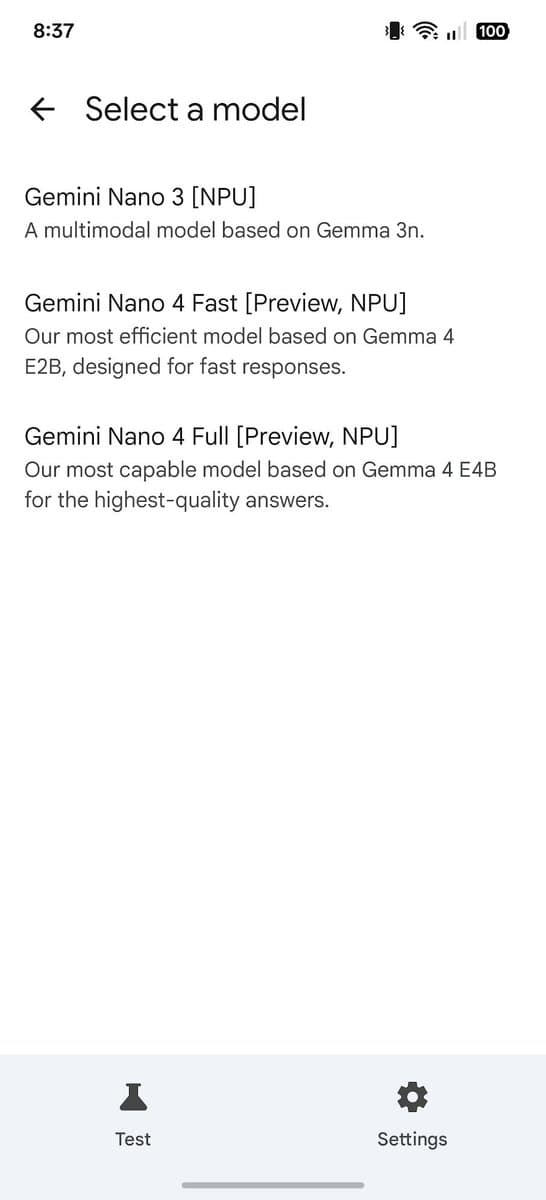
A new beta version of Google's AICore system service is enabling a more direct approach to on-device AI on Android. According to a report from leaker Mishaal Rahman, the beta allows users to manually download two variants of the Gemini Nano 4 model—"Full" and "Fast" (with NPU acceleration)—directly onto their Android phones. The process was demonstrated on a device powered by Qualcomm's latest Snapdragon 8 Elite Gen 5 chipset.
AICore is a foundational system service that Google has been integrating into Android to handle on-device AI workloads. Previously, the deployment of models like Gemini Nano was largely controlled by Google and device manufacturers, often bundled with system updates or specific app installations. This beta feature represents a shift, giving technically inclined users more direct control over which model version resides on their device.
The report notes that the AICore service itself "is included with every new Android phone," positioning it as a ubiquitous backend for AI capabilities. The ability to download specific model variants suggests Google is testing a more flexible, user-accessible model delivery system, potentially paving the way for users to choose between model size, capability, and power efficiency profiles.
What This Means for Android AI
The move to a user-downloadable model system has several immediate implications:
- Model Management: Users could potentially update, switch, or revert AI models without waiting for full OS updates.
- Hardware Optimization: The mention of a "Fast" variant with NPU (Neural Processing Unit) acceleration highlights the growing importance of dedicated AI hardware in mobile SoCs. This variant is likely optimized for lower latency on devices with capable NPUs like the one in the Snapdragon 8 Elite Gen 5.
- Developer Testing: A more accessible model deployment method would significantly ease testing for developers building apps that rely on AICore's on-device capabilities.
This development follows Google's steady integration of Gemini Nano into the Android ecosystem, which began with the Pixel 8 Pro and has since expanded to other flagship devices. The Gemini Nano models are designed to run entirely on-device, offering features like smart replies, summarization, and audio transcription without sending data to the cloud.
Technical Details and Availability
The feature is currently in a beta channel, indicating it's an early test and not yet a stable, public-facing tool. It was accessed through the AICore app's settings menu, which is typically hidden from standard users. The download process fetched the models directly, suggesting they are stored and managed separately from the core Android system image.
While the Snapdragon 8 Elite Gen 5 was used in the demonstration, the underlying AICore service is designed to be chipset-agnostic, meaning the feature could eventually extend to devices with Google's own Tensor chips, MediaTek's Dimensity series, and other platforms with capable NPUs.
gentic.news Analysis
This move by Google is a logical next step in the maturation of its on-device AI strategy. For years, the narrative has been about bringing AI to the edge, but the implementation has often been opaque and manufacturer-dependent. By testing a user-facing model downloader within AICore, Google is experimenting with a framework that could standardize and democratize access to the latest on-device models, much like Google Play Services updates core APIs independently of Android versions.
This aligns with a broader industry trend we've covered, such as in our analysis of Meta's on-device Llama deployments, where control over model deployment is key to rapid iteration. Google's approach, however, is more systemic, baking the capability into a core Android service. It also directly competes with the vision of companies like Qualcomm, which promotes its AI Hub for optimized model deployment on its hardware. Google's AICore aims to be the universal middleware, potentially reducing fragmentation.
The timing is significant. With the Snapdragon 8 Elite Gen 5 and next-generation Tensor chips pushing mobile NPU performance, the hardware is finally capable of running more substantial models efficiently. A user-downloadable system allows Google to push new model architectures or fine-tunes that leverage these hardware advances without being gated by the slow pace of Android version adoption. This could accelerate the on-device AI feature race against Apple and its Apple Intelligence suite, which is deeply integrated into iOS but follows a different, more locked-down distribution model.
Frequently Asked Questions
What is Google AICore?
AICore is a system-level Android service developed by Google that manages on-device AI and machine learning workloads. It provides a common platform for features powered by models like Gemini Nano, handling tasks such as model execution, resource management, and hardware acceleration.
Can I download Gemini Nano 4 on my phone now?
The user-initiated download feature is currently only available in a beta version of the AICore service and was demonstrated by a technical leaker. It is not a stable, publicly released feature for general consumers. Typically, Gemini Nano is deployed by Google and device manufacturers through system updates.
What is the difference between Gemini Nano 4 Full and Fast?
Based on the naming, "Gemini Nano 4 Full" is likely the standard or more capable version of the model. "Gemini Nano 4 Fast" is explicitly noted as having NPU acceleration, suggesting it is a version optimized for lower latency and higher efficiency on devices equipped with a powerful Neural Processing Unit, potentially at the cost of some accuracy or capability compared to the "Full" variant.
Why is on-device AI like Gemini Nano important?
On-device AI processes data directly on your smartphone without needing an internet connection to send information to the cloud. This enables faster response times, guarantees functionality offline, and significantly enhances privacy and security since personal data (like message contents or audio recordings) never leaves your device.