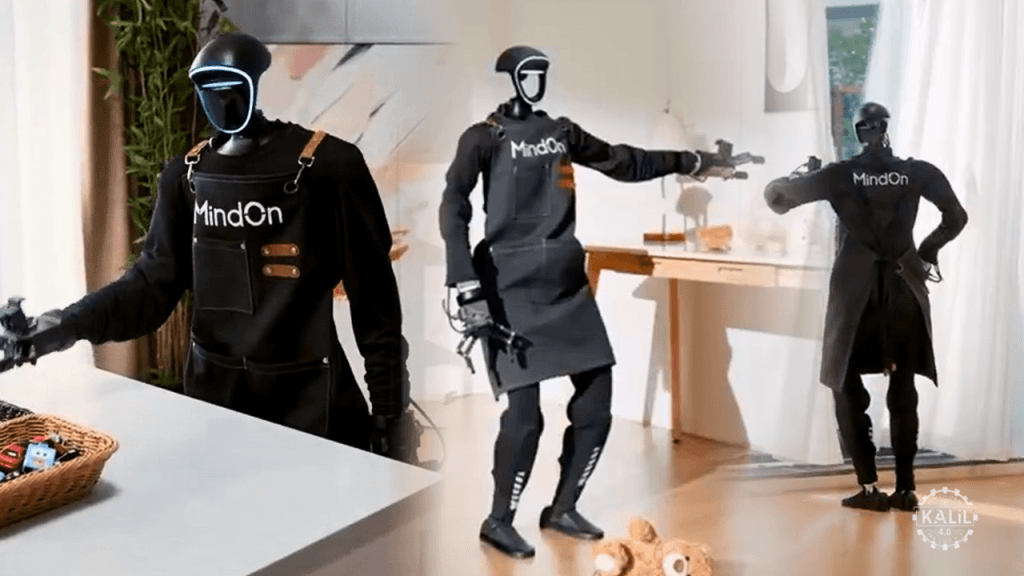
A six-month-old AI startup, MindOn, has released a demonstration video showing a Unitree G1 humanoid robot performing household tasks with full autonomy. The demo, shared on social media, features the robot successfully picking up scattered items from a floor, a foundational skill for domestic assistance.
What Happened
MindOn, a startup founded in late 2025, published a video of a Unitree G1 robot operating without human intervention. The core task demonstrated was picking up multiple objects that were scattered on the floor, a common and challenging scenario for home robots. The robot navigated to the items, used its manipulators to grasp them, and presumably placed them in a designated location, completing the chore sequence from start to finish.
The demonstration is notable for its claim of "fully on its own" operation, suggesting the system integrates perception, planning, and motor control into a single autonomous pipeline, likely driven by a learned policy or a large vision-language-action model.
Context
The Unitree G1 is a cost-optimized, electric-motor humanoid robot platform released by Unitree Robotics in 2024. It is designed as a developer-friendly platform for research and commercial applications in embodied AI. Its affordability relative to other humanoids like the Boston Dynamics Atlas or Tesla's Optimus has made it a popular testbed for startups and labs.
MindOn's rapid progress from founding to a functional demo in six months reflects the accelerating pace of development in embodied AI, where large foundation models trained on internet-scale data are being fine-tuned for physical control. The task of "tidying up" is a major benchmark for home robots, requiring robust object recognition, grasp planning amid clutter, and sequential task execution.
gentic.news Analysis
This demo from MindOn is a data point in the intense, fast-moving race to develop practical embodied AI. The use of the Unitree G1 platform is strategic; as we covered in our analysis of the 2025 humanoid landscape, the G1's sub-$20,000 price point has democratized access, allowing well-funded software startups like MindOn to iterate quickly without the billion-dollar capital burden of also building custom hardware. This mirrors the approach of other AI-native robotics firms like 1X Technologies and Figure AI, which we reported secured massive funding rounds in 2024 and 2025 to pair their neural networks with off-the-shelf or partner hardware.
The claim of full autonomy for a multi-step tidying task suggests MindOn's technical approach likely involves an end-to-end neural policy or a sophisticated agent framework built atop a large model (e.g., GPT-4V, Claude 3.5 Sonnet, or a custom vision-language model). The critical challenge isn't a single successful pick-and-place, but robustness—the ability to handle unseen objects, recover from failed grasps, and navigate dynamic environments. The demo doesn't show failure modes or success rates, which are the true metrics of readiness.
This development directly pressures established players. Google's DeepMind has published extensively on RT-2 and other robotics transformer models, while Tesla's Optimus team regularly releases slick videos. MindOn's move shows that a small, agile team can now produce a compelling result that, at least superficially, competes with these giants. The next validation step will be independent benchmarking on suites like BEHAVIOR or RLBench to see how their system's performance and sample efficiency compare to published state-of-the-art. If MindOn can demonstrate superior generalization with less data, they would become a compelling acquisition target for a major tech company seeking to leapfrog in robotics.
Frequently Asked Questions
What is the Unitree G1 robot?
The Unitree G1 is a general-purpose humanoid robot platform developed by Chinese robotics company Unitree. It stands approximately 1.27 meters tall, weighs 35 kg, and is equipped with electric actuators, a depth camera, and LiDAR. It is marketed as a low-cost, high-performance platform for research and development in embodied AI and robotics applications.
What does "fully autonomous" mean in this context?
In this demo, "fully autonomous" likely means the robot performed the entire task sequence—from visually detecting the scattered items, planning a path and a series of grasps, to executing the physical motions—without any human teleoperation or step-by-step coding. The high-level instruction (e.g., "pick up the items") was given, and the robot's onboard AI system handled the rest.
How does MindOn's approach differ from traditional robotics?
Traditional robotic manipulation for such tasks often involves meticulously programmed waypoints, predefined object models, and structured environments. MindOn's approach is almost certainly based on modern machine learning, where a model is trained on vast datasets of images, videos, and possibly simulated interactions. This allows the robot to generalize to unseen objects and slightly varied environments, though within limits.
What are the main challenges for robots doing household tasks?
The main challenges are generalization (handling the infinite variety of household objects and layouts), robust manipulation (grasping delicate, heavy, or slippery items reliably), long-horizon planning (breaking down a complex chore like "clean the kitchen" into hundreds of correct steps), and safe interaction in dynamic human environments. Current systems are brittle and often require controlled conditions.