What Happened
A new research paper, "Relative Contrastive Learning for Sequential Recommendation with Similarity-based Positive Pair Selection," was posted to arXiv on April 2, 2026. The work proposes a novel training framework designed to improve the performance of deep learning models that predict a user's next action based on their past interaction history—a core task known as sequential recommendation (SR).
The central innovation is a method to generate better training signals for these models using contrastive learning (CL), a self-supervised technique that teaches a model to distinguish between similar and dissimilar data points.
Technical Details
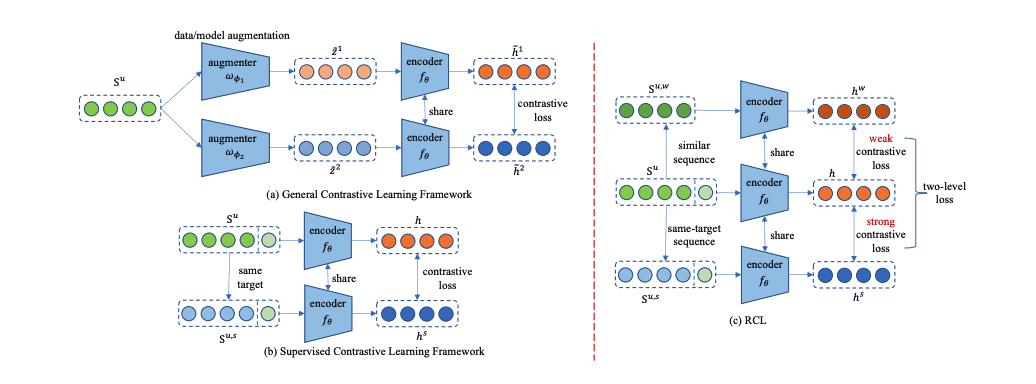
The paper identifies a key limitation in existing CL approaches for SR. Traditional methods often create "positive" training samples via data augmentation—like randomly reordering or substituting items in a user's history—but these operations can distort the original user intent. An alternative, Supervised Contrastive Learning (SCL), uses sequences that end with the same target item as positives. However, such identical sequences are rare, leading to a scarcity of training signals.
The proposed Relative Contrastive Learning (RCL) framework solves this by introducing a dual-tiered positive sample selection:
- Strong Positives: Sequences with the same target item (as in SCL).
- Weak Positives: Sequences that are semantically similar in their progression but end with a different target item.
For example, a sequence ending with a user purchasing a silk tie might use another tie-buying sequence as a strong positive. It could use a sequence where a user browsed similar formalwear (e.g., cufflinks, a pocket square) but ultimately bought a different item as a weak positive.
The RCL module then employs a weighted relative contrastive loss. This loss function does not just pull representations of positive pairs closer together. It specifically enforces that an anchor sequence's representation is closer to its strong positives than to its weak positives. This creates a more nuanced and information-rich learning objective.
The authors applied RCL on top of two mainstream SR model architectures. Empirical results across five public datasets and one private dataset show that RCL delivers an average improvement of 4.88% over state-of-the-art SR methods.
Retail & Luxury Implications
This research is directly applicable to the core engine of digital retail: the next-item recommendation system. For luxury and fashion retailers, where customer journeys are often highly curated and sequential (e.g., viewing a runway show → exploring a lookbook → adding an item to a wishlist → purchasing), accurately modeling sequence intent is paramount.

Potential Applications:
- Post-Purchase & Cross-Sell: After a customer buys a handbag, the model could more accurately recommend complementary items (shoes, scarves) by understanding sequences of customers with similar taste profiles, even if they didn't buy the exact same bag.
- Session-Based Recommendations: For anonymous browsing sessions on a website or app, RCL could improve real-time "customers also viewed" and "complete the look" suggestions by better matching the current session's intent to historically similar sessions.
- Longitudinal Customer Modeling: For loyalty program members, the model could refine its understanding of a customer's evolving style by learning from sequences of similar customers, leading to more personalized seasonal campaign recommendations.
The key advantage for luxury is the potential for more intent-aware, rather than just item-similar, recommendations. This moves beyond "you bought X, so buy Y" to "your journey resembles this group's journey, which often leads to Z."
Implementation Approach
Integrating RCL into an existing production SR pipeline would be a significant engineering undertaking, suitable for teams with mature MLOps practices.
Technical Requirements:
- Data Pipeline: Requires access to granular, timestamped user interaction sequences (views, adds-to-cart, purchases).
- Model Retraining: RCL is a training framework, not an inference-time model. It necessitates retraining or fine-tuning existing SR models (like GRU4Rec or SASRec), which requires substantial GPU resources.
- Similarity Computation: The weak positive selection module requires an efficient way to compute sequence similarity, adding pre-processing overhead.
- A/B Testing Infrastructure: To validate the claimed 4-5% lift in a live environment, robust A/B testing capabilities are essential, measuring downstream metrics like conversion rate and average order value.
Complexity: High. This is a cutting-edge research technique, not an off-the-shelf SaaS solution. It would require a dedicated team of machine learning engineers and researchers to adapt, productionize, and maintain.
Governance & Risk Assessment
- Privacy: Using detailed user sequences for training intensifies data privacy obligations. All training must comply with GDPR, CCPA, and internal data governance policies, likely requiring robust anonymization or federated learning approaches.
- Bias: The model learns from historical sequences. If past recommendations or customer behaviors reflect societal or systemic biases (e.g., steering certain demographics toward lower-value items), RCL could inadvertently amplify these patterns by learning from "similar" sequences. Proactive bias auditing is critical.
- Maturity: This is an arXiv preprint, meaning it has not undergone formal peer review. While the results are promising, the method is in a research stage. Production readiness is likely 12-24 months away, pending independent validation and optimization for scale.