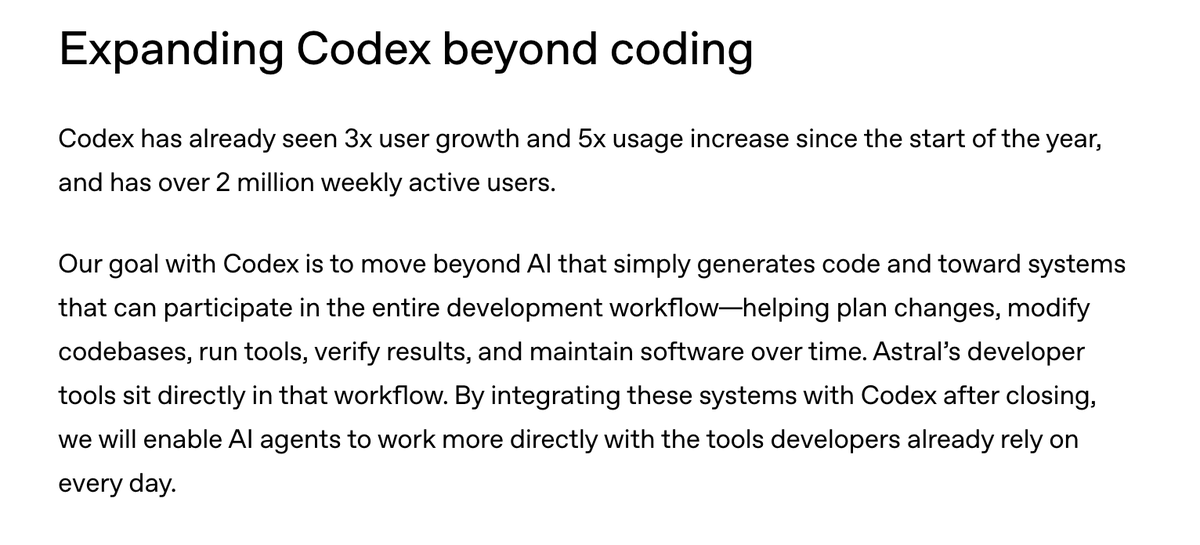
A retweet from developer Thibaut Sottiaux, shared by AI commentator Matthew Weinbach, reveals a significant milestone for OpenAI's flagship code generation model. Weekly active users of Codex have grown from 2 million to 3 million in under a month, representing a 50% increase in a very short timeframe.
What Happened
The source is a simple retweet of a post by Thibaut Sottiaux, which states: "Three million people are now using Codex weekly - up from two million a little under a month ago. Incredible to see the growth…"
This is a user metric, not a technical benchmark, but it is a critical business and adoption indicator for one of the most influential AI models powering the current wave of developer tooling.
Context
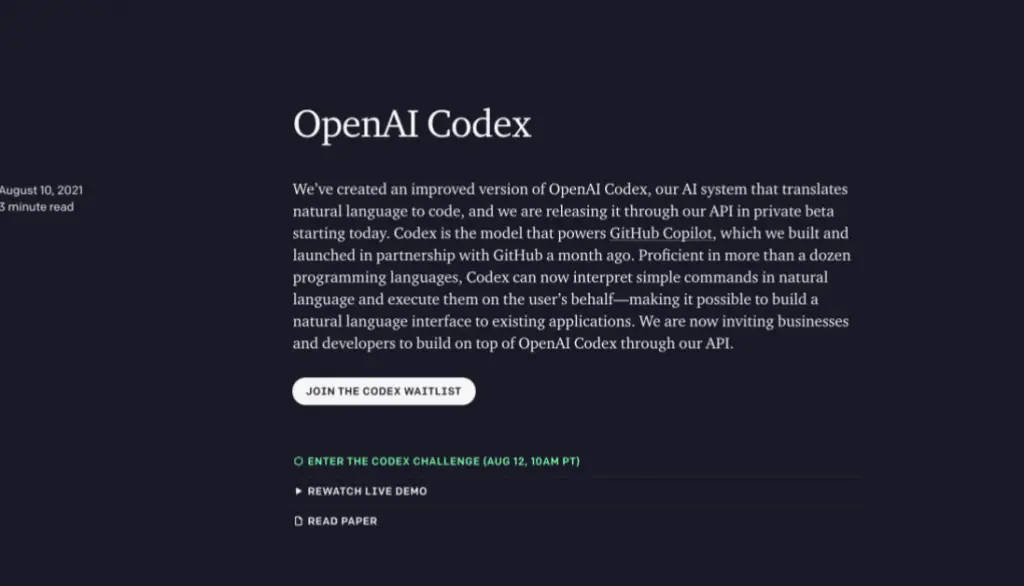
OpenAI Codex is the model that powers GitHub Copilot, the AI pair programmer launched in 2021. It is a descendant of GPT-3 fine-tuned on a massive corpus of public code. While GitHub Copilot is its most famous application, Codex is also available via the OpenAI API, powering a wide range of third-party coding tools, internal developer platforms, and educational applications.
User growth from 2 million to 3 million weekly users in "a little under a month" suggests a steepening adoption curve. This is likely driven by several concurrent factors:
- Enterprise Rollouts: Initial pilot programs within large companies graduating to broader, mandated usage.
- Toolchain Integration: Codex and similar models are becoming embedded into more IDEs and development workflows beyond just GitHub's ecosystem.
- Reduced Friction: Improvements in tooling, onboarding, and user experience lowering the barrier to daily use.
gentic.news Analysis
This growth metric is a strong trailing indicator of a fundamental shift in software development. The 50% monthly growth rate is staggering for a tool that is nearly three years old, suggesting we are past the early adopter phase and into early majority adoption within the professional developer community.
This surge likely reflects two major trends we've been tracking. First, the enterprise normalization of AI coding assistants. What began as an optional plugin is now becoming a standard part of the software development lifecycle in many organizations, driven by tangible productivity claims. Second, it highlights the platform durability of foundational models. Despite the launch of newer, more capable code models from competitors like DeepSeek, Anthropic (Claude Code), and Google (Gemini Code Assist), Codex—via Copilot—maintains a formidable first-mover advantage and ecosystem lock-in through deep GitHub integration.
The growth also puts quantitative pressure on the economic model. At scale, the inference costs for serving 3 million weekly active users generating code completions are immense. This user base validates the market but also underscores the extreme compute infrastructure required to serve it profitably. It reinforces why Microsoft (OpenAI's primary investor and GitHub's owner) is investing billions in AI-specific data centers—the service demands it.
Frequently Asked Questions
What is OpenAI Codex?
OpenAI Codex is a generative AI model specialized for understanding and writing code. It is a descendant of GPT-3 that was fine-tuned on a vast dataset of public source code. Its primary public-facing application is powering GitHub Copilot, which suggests code completions and entire functions directly within a developer's integrated development environment (IDE).
How does Codex's growth compare to other AI coding tools?
While specific user numbers for direct competitors like Amazon CodeWhisperer or Google's Gemini Code Assist are not publicly disclosed at this granularity, a jump from 2M to 3M weekly users in a month suggests Codex (via Copilot) is maintaining or accelerating its market leadership. This growth is likely unmatched in sheer volume, though newer entrants may show higher percentage growth from a much smaller base.
Does 3 million "users" mean 3 million paying subscribers?
Not necessarily. The metric is "people using Codex weekly." This includes users across different access points: paying GitHub Copilot subscribers, users on free trials, developers using it through the OpenAI API in other products, and potentially users in academic or research settings. However, the core of this growth is almost certainly tied to commercial Copilot subscriptions, indicating robust revenue growth for GitHub.
What does this growth mean for the future of software development?
This level of adoption signifies that AI-assisted coding is transitioning from a novelty to a standard practice. For developers, it means proficiency with these tools is becoming a core skill. For companies, it implies that development velocity and code standardization expectations are rising. For the industry, it creates a new layer of infrastructure dependency on the AI model providers (OpenAI, Microsoft) that power these essential tools.