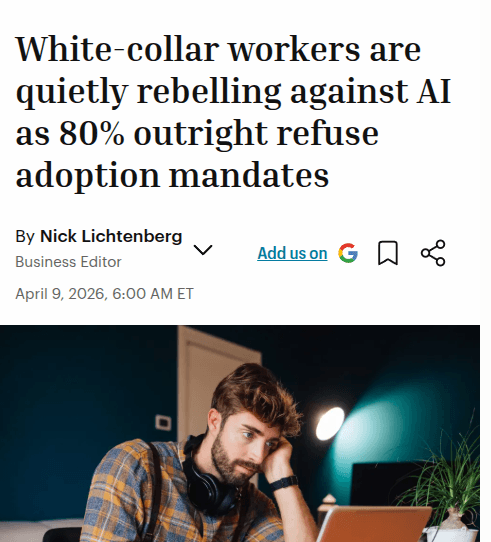
A new report from Fortune reveals a stark disconnect in the corporate AI revolution: while companies pour millions into AI infrastructure and tools, the vast majority of their employees are simply not using them. According to the survey, roughly 80% of enterprise workers either skipped the company-provided AI tools, reverted to manual work, or did not use AI at all for their tasks.
This resistance persists even as companies continue to aggressively raise spending on digital transformation initiatives. The report identifies a clear blame gap: executives declare the tools ready for prime time, while frontline workers describe them as confusing, poorly explained, and untrustworthy for making serious decisions.
The article, citing a growing "white-collar rebellion," frames this as a critical failure in adoption, where massive investment is not translating into productivity gains or workflow integration.
The Core Disconnect: Investment vs. Adoption
The Fortune report, based on survey data, crystallizes a problem that has been simmering in enterprise tech circles. The findings suggest that the top-down mandate to "implement AI" is crashing into the reality of daily work. Workers are presented with tools—whether for code generation, document summarization, or data analysis—that they find unintuitive, inadequately supported by training, or too risky to rely on for consequential output.
This creates a scenario of phantom ROI. Companies are accruing the costs (licenses, compute, implementation) but not realizing the promised benefits of efficiency and augmentation because the tools sit unused.
The "Skill Issue" Debate
The report's findings have sparked debate online. Some observers, like the source tweet's author, suggest the core problem is a "skill issue"—a lack of employee proficiency or willingness to learn new technologies. Others argue the fault lies with enterprise leaders who purchase generic, poorly integrated solutions without understanding employee workflows or providing meaningful support.
The truth likely lies in the middle: successful adoption requires both well-designed, context-aware tools and a workforce equipped with the literacy to use them effectively. The Fortune data indicates that, for most companies, neither condition is being met.
gentic.news Analysis
This report is a critical reality check in the enterprise AI narrative. For the past two years, the dominant story has been one of relentless investment and capability expansion, from the launch of GPT-4 and Claude 3 to the proliferation of enterprise-focused copilots from Microsoft, Google, and Salesforce. However, this Fortune data exposes the last-mile problem of AI adoption: getting it from the CIO's slide deck into an employee's daily habit.
This aligns with a trend we've noted in our coverage of tools like GitHub Copilot and Microsoft 365 Copilot—initial excitement often gives way to nuanced discussions about integration, cost, and measurable impact. The high-profile struggles of companies like IBM, which has aggressively pivoted to AI while facing complex restructuring, show that betting the business on AI is easier said than done. Furthermore, this worker resistance may partially explain the recent cooling in some areas of the generative AI startup funding landscape, as investors begin to demand clearer paths to user adoption and revenue, not just technical demos.
The "skill issue" argument, while reductive, points to a genuine and growing market need: AI training and change management. This disconnect represents a major opportunity for consultancies and platform providers who can bridge the gap between powerful models and usable, trusted workplace tools. The next phase of enterprise AI won't be won by the model with the best benchmark, but by the ecosystem that best solves this adoption crisis.
Frequently Asked Questions
What percentage of workers are not using company AI tools?
According to the Fortune survey cited in the report, roughly 80% of enterprise workers are not using the AI tools provided by their company. They either avoid them, do the work manually, or do not use AI at all for their tasks.
Why are employees refusing to use AI at work?
The report states that employees find the tools confusing, poorly explained, and untrustworthy for making serious decisions. This indicates a failure in tool design, integration, training, and change management, creating a gap between executive promises and employee experience.
What is the business impact of this AI adoption gap?
The impact is a significant waste of investment. Companies are spending millions on AI software, licenses, and infrastructure (a cost reflected in "digital transformation" budgets), but are not realizing the expected return on investment because the tools are not being used to improve productivity or workflows.
Is this just a "skill issue" for employees?
While a lack of skill or resistance to change is a factor, the report suggests the problem is systemic. Executives are purchasing tools declared "ready" without ensuring they fit employee needs or are supported by adequate training and trust-building measures. It is an adoption and implementation failure, not solely a user proficiency problem.