In a direct challenge to the subscription-based AI coding assistant market, Jack Dorsey's financial services company Block has launched Goose, a free and open-source AI agent designed to autonomously handle coding tasks. The announcement positions Goose as a zero-cost alternative to tools like GitHub Copilot ($19/month) and Anthropic's Claude Code ($200/month).
What Happened
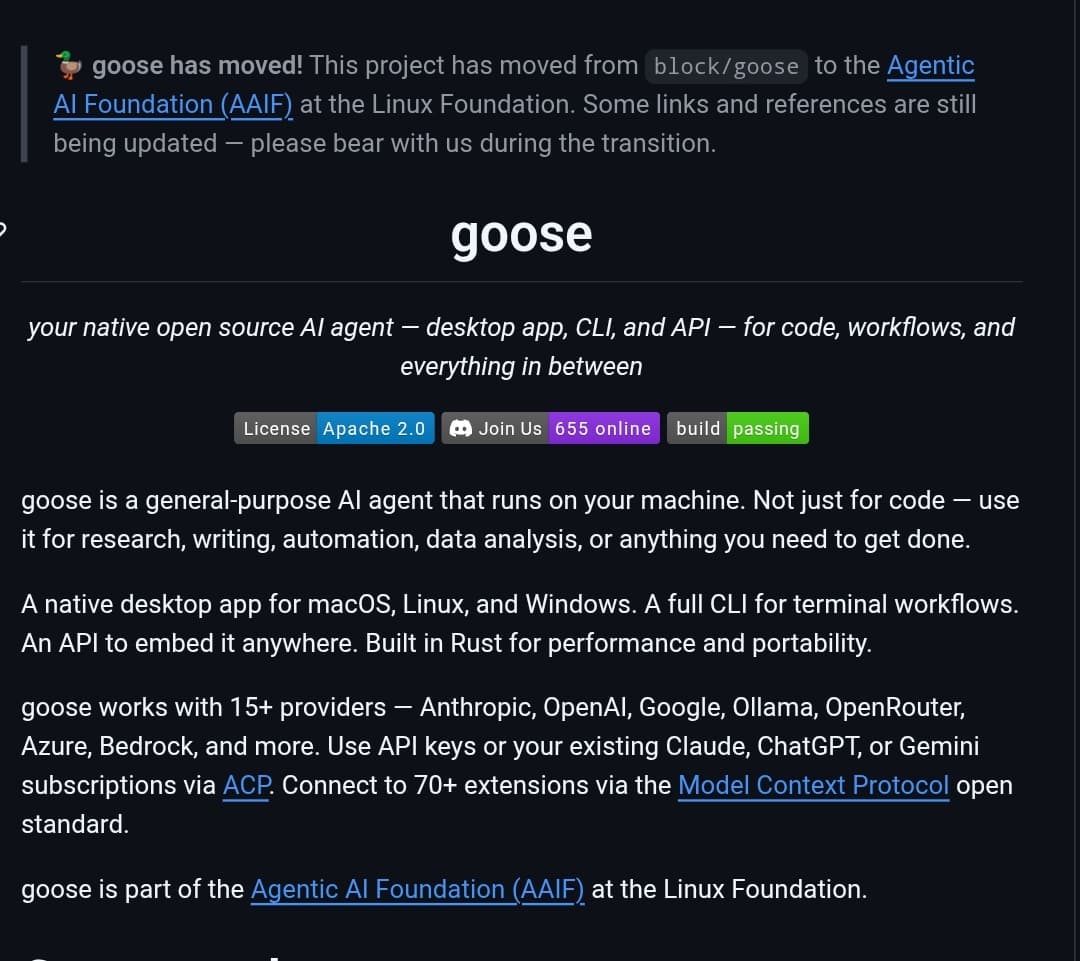
Block, the company behind Square and Cash App, has released Goose as a publicly available project. According to the announcement, Goose is an AI agent that can install dependencies, execute code, edit files, and run tests autonomously. It is described as a free, open-source tool that works with any Large Language Model (LLM) and supports Model Context Protocol (MCP) servers. It is available both as a desktop application and a command-line interface (CLI).
Technical Details
The core proposition of Goose is its agentic workflow for code execution. Unlike chat-based coding assistants that suggest code snippets, Goose is designed to take action within a development environment. Key features include:
- Model Agnostic: Works with any LLM via API, allowing users to plug in their preferred model (e.g., OpenAI's GPT-4, Anthropic's Claude, or open-source models).
- MCP Server Support: Integrates with the Model Context Protocol, a standard for connecting LLMs to external data sources and tools, potentially allowing Goose to interact with databases, APIs, and other services.
- Autonomous Execution: Can perform the full cycle of installing necessary packages, executing code, making edits based on results or instructions, and running tests.
- Dual Interface: Offers both a graphical desktop app for ease of use and a CLI for integration into automated pipelines and developer workflows.
Market Context & Competitive Landscape
The launch directly targets the economics of the booming AI-powered developer tools sector. GitHub Copilot, with over 1.8 million paid users as of late 2025, has established the ~$20/month price point for AI pair programmers. Anthropic's Claude Code, part of its higher-tier Claude Pro offering, commands a $200/month price for its advanced coding capabilities.
Goose Block (Jack Dorsey) Free & Open-Source Any LLM (Agnostic) Autonomous code execution & testing agent GitHub Copilot Microsoft/GitHub $19/month OpenAI & In-House Deep IDE integration, massive user base Claude Code Anthropic $200/month (Claude Pro) Claude 3.5 Sonnet Advanced reasoning, large context window Cursor Cursor $20/month OpenAI AI-native IDE, agent-like featuresBlock's move follows a pattern of major tech companies releasing influential open-source AI tools, such as Meta's Llama models, to shape ecosystem development. By open-sourcing Goose, Block avoids direct model competition and instead focuses on the orchestration layer, potentially encouraging adoption of its broader platform and services.
What to Watch
The critical questions for developers and the market will be:
- Performance & Reliability: How effectively does Goose's autonomous execution work compared to human-in-the-loop tools? Early benchmarks and user reports on success rates for complex tasks will be key.
- Security & Safety: Autonomous code execution carries inherent risks. The design of Goose's permission sandbox and safety controls will be heavily scrutinized.
- Ecosystem Play: As an open-source, model-agnostic agent, Goose's success may hinge on community adoption and the breadth of MCP server integrations developed around it.
gentic.news Analysis
This launch is a strategic open-source play by Block in a crowded, fee-based market. It's less about competing on AI model quality and more about commoditizing the agentic orchestration layer for coding. By making the agent free and open-source, Block incentivizes developers to build workflows around it, potentially driving traffic and value to its core financial services. This follows a similar playbook to Google's release of Kubernetes or Meta's release of PyTorch—create the dominant orchestration platform, and the ecosystem follows.
The move also highlights the rapid evolution of AI coding tools from copilots to agents. While Copilot and Claude Code are primarily interactive assistants, Goose is architected for autonomy. This aligns with the broader industry trend we covered in [Article on Devin & AI Software Engineers] towards AI systems that can complete entire software development tasks. However, Goose's model-agnostic, open-source approach differentiates it from vertically integrated, closed-agent offerings.
For practitioners, Goose represents an immediately accessible platform for experimenting with AI coding agents without subscription fees. Its support for MCP servers is particularly notable, as it taps into a growing standard for tool integration. The success of this launch will depend on whether the developer community embraces it and builds the necessary integrations and safety guardrails, or if it remains a niche tool overshadowed by the seamless integration and robust feature sets of its paid competitors.
Frequently Asked Questions
Is Goose really completely free?
Yes, according to the announcement, Goose is released as a free and open-source project. There are no stated subscription fees for the agent software itself. However, users must provide their own API keys for the LLM they choose to use with it (e.g., OpenAI, Anthropic, etc.), which may incur costs from those model providers.
How does Goose compare to GitHub Copilot?
GitHub Copilot is a deeply integrated code completion and chat tool within your IDE. Goose is an autonomous agent that operates more like a separate worker: it can execute commands, install packages, run tests, and edit files based on high-level instructions. Copilot assists you as you type; Goose can be tasked to complete a multi-step job on its own.
What are MCP servers, and why do they matter for Goose?
MCP (Model Context Protocol) servers are a standard, pioneered by Anthropic, that allow LLMs to connect to external data sources and tools (like databases, calendars, or APIs). Goose's support for MCP means it can be extended to interact with a wide variety of tools beyond just the codebase, making it a more general-purpose autonomous agent for software-related tasks.
Is Goose safe to run on my codebase?
As with any tool that has autonomous execution capabilities, caution is advised. The security model will depend on the permissions granted to the Goose agent and the sandboxing environment it runs in. It is crucial to review the open-source code, understand its capabilities, and likely test it in a isolated environment or on non-critical projects before trusting it with production code.