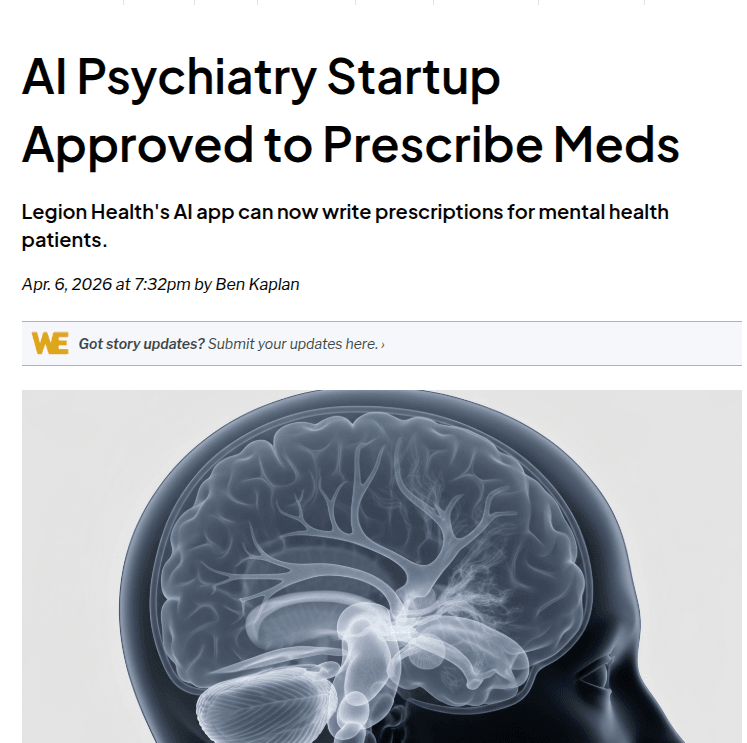
San Francisco-based startup Legion Health has received regulatory permission in California to use an AI chatbot to renew certain psychiatric prescriptions without requiring a doctor to sign off on every individual case. This represents one of the first instances where an AI system has been granted autonomous decision-making authority within a regulated clinical workflow, moving beyond advisory roles.
What's Approved: A Narrow, Guardrailed Experiment
The permission, granted by California state regulators, is intentionally restrictive. It is not a blanket approval for AI to practice medicine.
The AI's permitted scope is limited to:
- Renewing prescriptions for only 15 specific, lower-risk maintenance drugs.
- Patients who are already stable on their existing medication regimen.
- Renewals only—the system is explicitly blocked from writing new prescriptions, changing doses, or prescribing controlled substances, benzodiazepines, antipsychotics, or lithium.
The system includes mandatory human oversight triggers. The AI must immediately escalate a case to a human clinician if it detects or the patient reports:
- Suicidality or mania
- Severe side effects
- Pregnancy
- Any patient request to speak with a person
Legion Health's system is designed as a "first-pass" tool for administrative efficiency. It handles the routine renewal decision for a clearly defined patient cohort, while human psychiatrists, pharmacists, and regulators remain in the loop for oversight, complex cases, and all initial diagnoses.
Technical & Operational Implications
While the source material does not specify the AI's architecture, the approval implies a system built for high-reliability classification within a narrow domain. The core technical challenge is not open-ended diagnosis but determining patient stability and contraindications based on structured inputs and possibly natural language interactions.
Operationally, this shifts the clinician's role from performing every renewal to supervising an AI agent. The model likely follows a decision-tree or classifier-based approach, trained on historical cases of stable vs. unstable patients, with hard-coded rules for the mandatory escalation criteria. Performance will be measured by its accuracy in identifying cases that need human review, not by its diagnostic creativity.
The Competitive and Regulatory Landscape
This approval places Legion Health at the forefront of a contentious frontier: autonomous AI clinical decision-making. Other digital health companies like Hippocratic AI and Nabla have focused on AI assistants for note-taking or patient triage, but not on final prescription authority. Legacy electronic health record (EHR) vendors like Epic have integrated predictive models for sepsis or deterioration, but these are alert systems, not decision endpoints.
The California regulator's cautious, guardrailed approach sets a potential blueprint for other states and the FDA. It demonstrates a pathway to deployment that prioritizes safety through limitation—starting with a narrow drug list, stable patients, and clear off-ramps to human care.
What This Means in Practice
For stable patients on maintenance medications like certain SSRIs (Selective Serotonin Reuptake Inhibitors), this could reduce wait times for prescription renewals. For psychiatrists, it could automate a time-consuming administrative task, allowing them to focus on patients requiring more complex care. The success of this experiment will hinge on the AI's false-negative rate—its ability to correctly identify all cases that need human intervention without missing any.
gentic.news Analysis
This development is a direct, concrete step in the trajectory of clinical AI moving from "assistant" to "agent." It follows a pattern of incremental regulatory acceptance, similar to the FDA's 510(k) clearances for AI-based diagnostic imaging tools from companies like Aidoc and Zebra Medical Vision. However, those tools analyze scans; Legion Health's system makes a discrete clinical decision with direct patient impact—a significant regulatory leap.
This aligns with a broader trend we've covered of vertical AI in healthcare gaining traction, where startups build deep, specialized models for specific clinical workflows rather than general-purpose medical chatbots. The approval likely results from Legion Health demonstrating rigorous validation studies to regulators, proving its system's performance within the extremely narrow scope defined.
Looking ahead, the key metric to watch will be outcome data. If Legion Health can publish data showing non-inferiority in patient outcomes and high accuracy in escalation over, say, 10,000 renewal decisions, it will create immense pressure for scaling the model's scope (more drugs, more conditions) and geographic expansion. Conversely, a single high-profile failure could set the entire field back years. This approval is not the end of the debate but the beginning of a critical real-world experiment.
Frequently Asked Questions
What drugs can the Legion Health AI prescribe?
The AI is approved to renew prescriptions for only 15 specific, lower-risk maintenance drugs for psychiatric conditions. The exact list is not published in the source, but it explicitly excludes controlled substances, benzodiazepines, antipsychotics, and lithium. It is likely limited to certain antidepressants (SSRIs/SNRIs) and non-addictive anti-anxiety medications for patients already stabilized on them.
Is this AI replacing psychiatrists?
No. The AI system is designed to handle a narrow, repetitive administrative task—renewing existing prescriptions for demonstrably stable patients. It cannot diagnose, initiate new treatments, handle complex cases, or manage crises. Human psychiatrists remain responsible for all initial diagnoses, treatment plans, dose changes, and any case where the AI's guardrails trigger an escalation.
How does the AI know if a patient is "stable"?
The source material does not specify the technical criteria. In practice, "stability" would be defined by the treating psychiatrist and likely involve a period of consistent treatment without hospitalizations, severe side effects, or significant symptom exacerbation. The AI's assessment would be based on patient-reported outcomes, clinical notes, and possibly structured questionnaires, all designed to flag any deviation from the stable baseline.
Could this approval happen in other states or countries?
California's approval creates a precedent, but each state's medical board and pharmacy board has its own regulations. Widespread adoption would require similar, state-by-state regulatory reviews. At a federal level, the U.S. Food and Drug Administration (FDA) has authority over AI as a medical device, but this type of clinical workflow tool may fall into a more complex regulatory category involving both software and professional practice standards.