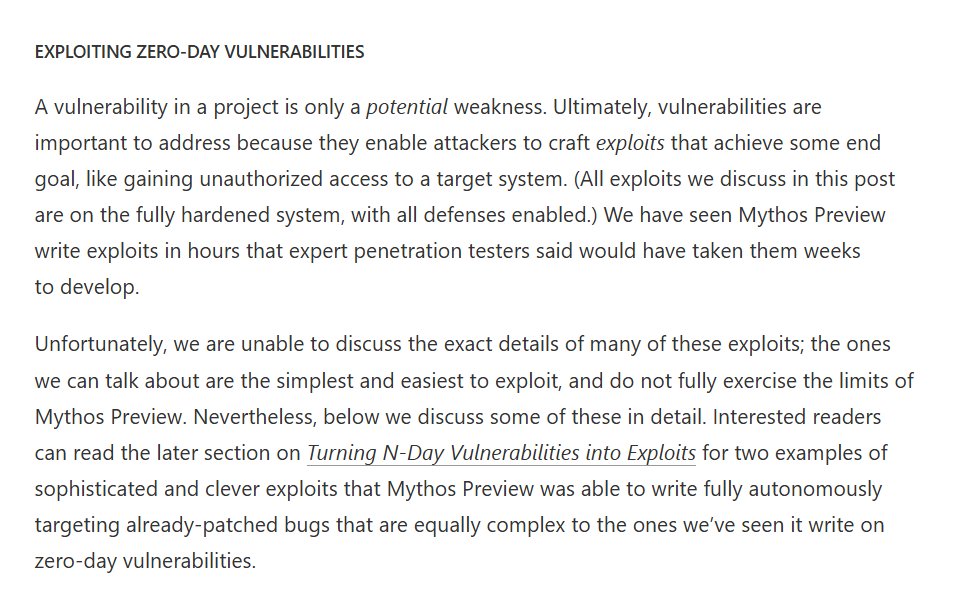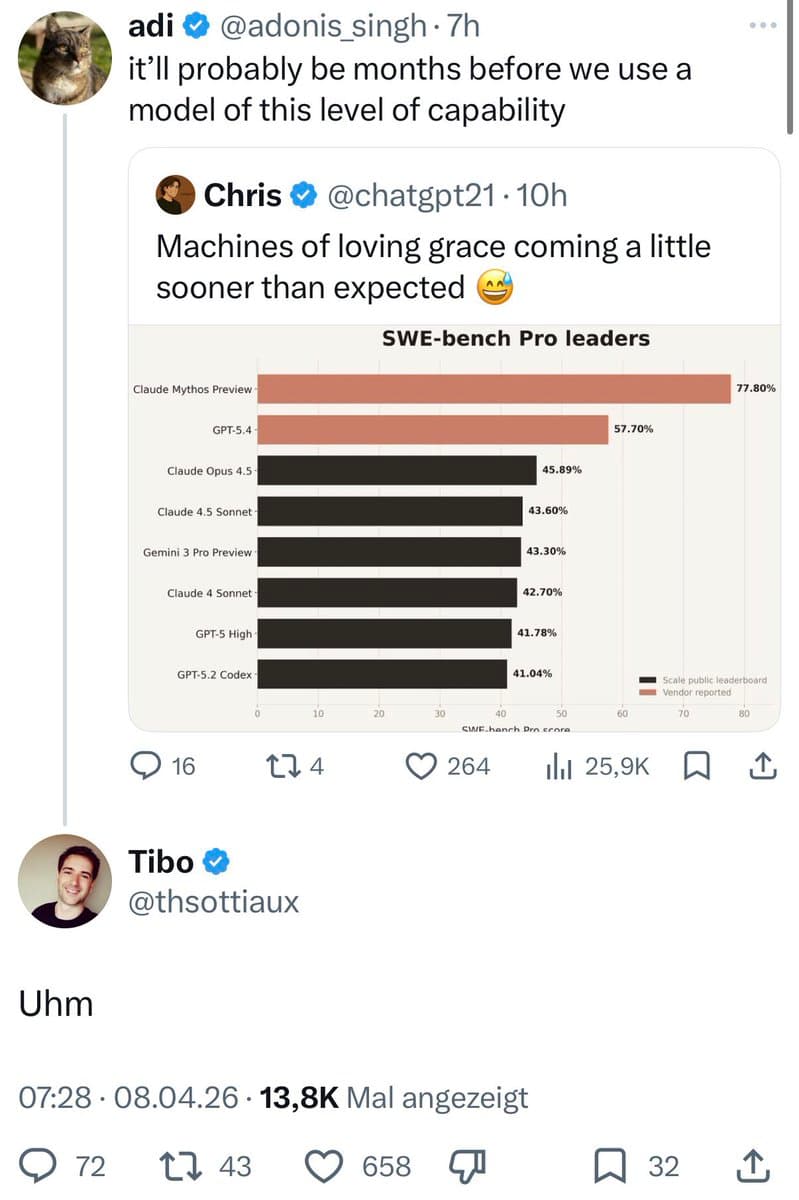
A brief social media post from an observer has sparked speculation that OpenAI is preparing to release—or is subtly hinting at—a new AI model positioned as a direct competitor to Mythos Max, the flagship reasoning model from AI21 Labs.
The source is a single tweet from user @kimmonismus, stating: "OpenAI is hinting or releasing a model comparable to Mythos." The tweet includes a link, but the linked content is not provided in the source material, leaving the nature of the "hint" unclear.
What Happened
The claim is based on an external observation, not an official announcement from OpenAI. The core assertion is that OpenAI's actions or communications are being interpreted as signaling a new model with capabilities similar to those of Mythos Max.
Context
Mythos Max is AI21 Labs' most advanced large language model, specifically engineered for complex reasoning tasks. It has been a significant contender in the high-performance reasoning segment, often benchmarked against models like OpenAI's GPT-4 series, Anthropic's Claude 3 Opus, and Google's Gemini Ultra.
If OpenAI is indeed preparing a new model aimed at this segment, it would represent the latest move in the ongoing competition to achieve state-of-the-art performance on demanding benchmarks for reasoning, coding, and mathematical problem-solving. This follows OpenAI's established pattern of iterative model releases, such as the GPT-4 Turbo update and various specialized variants.
What This Means in Practice
For developers and enterprises, a new OpenAI model targeting the Mythos Max benchmark would mean:
- A potential new top-tier option for advanced reasoning workloads.
- Increased competition likely leading to performance improvements and potentially more favorable pricing or rate limits across providers.
- The need to re-evaluate model selection for tasks requiring deep logical reasoning or code generation.
gentic.news Analysis
This rumor, while thin, fits neatly into the current competitive dynamics of the frontier model landscape. As we covered in our analysis of AI21 Labs' Jamba-Instruct model launch, AI21 has been aggressively carving out a niche with its Jurassic and Mythos model families, emphasizing reasoning efficiency. A direct competitive response from OpenAI would be a logical strategic move.
The timeline is also telling. The last major model announcement from OpenAI was GPT-4o in May 2024. Given the accelerated pace of the industry, a new flagship or specialized model release in early 2026 would align with expected development cycles. Furthermore, this activity coincides with a period of 📈 increased competitive intensity among model providers, with Anthropic, Google, and xAI all having released or teased advanced models in recent quarters.
If this hint materializes into an official release, the key metric to watch will be its performance on the MATH and GPQA Diamond benchmarks, where Mythos Max has established strong results. The architecture focus will also be critical; will it be a scaled-up version of existing transformer-based designs, or might it incorporate new modalities or a novel mixture-of-experts approach like their rumored "Strawberry" project? Practitioners should treat this as a signal to monitor OpenAI's official channels closely for any technical details or API updates.
Frequently Asked Questions
What is Mythos Max?
Mythos Max is the most advanced large language model developed by AI21 Labs. It is specifically optimized for complex reasoning, competitive programming, and mathematical problem-solving, and is often positioned as a top-tier alternative to models like GPT-4 and Claude 3 Opus.
Has OpenAI officially announced this model?
No. As of now, there is no official announcement from OpenAI. The information originates from an observational social media post interpreting OpenAI's communications or actions as a hint toward such a model.
What would a model "comparable to Mythos" likely do?
A model aiming to compete with Mythos Max would likely target superior performance on benchmarks that test advanced reasoning, logical deduction, and code generation. It would be positioned for enterprise and research applications where deep, chain-of-thought reasoning is required, rather than general conversational ability.
How can I stay updated on this?
For confirmed information, watch OpenAI's official blog (openai.com/blog) and API documentation. For early signals and industry analysis, follow technical AI news outlets that track model releases and benchmark leaderboards.